Story text
Size
Small
Standard
Large
Width
*
Standard
Wide
Links
Standard
Orange
* Subscribers only
Learn moreIn 2015, biomedical entrepreneurElizabeth Holmeswas Silicon Valley’s golden girl, lauded as the youngest and richest self-made female billionaire thanks to the company she founded, Theranos, which was valued at $9 billion at the height of its success. Then it all camecrashing downwhen accusations of fraud surfaced about the company’s signature blood-testing device, culminating in a sensational trial. Holmeswas convictedon four counts and sentenced to 11 years in prison.
Holmes is back in the headlines thanks to a new film,You Can See Everything, which depicts the final days before Holmes, having exhaustedher appeals, went to prison. Co-directed byNathan FielderandLance Oppenheim, it’s a surreal, absurdist piece that has largely been received with gushing enthusiasm and no small amount of hype, with some declaring it the best film of the year. A fewcontrarian voiceshaveemergedover the pastweekwith much-needed reality checks, but there’s no denying the film is destined to be an awards-season darling.
Pardon me for joining the buzzkills, but I cannot in good conscience jump on theYou Can See Everythingbandwagon. Sure, it has its moments, and the second half is highly entertaining, but there’s nothing here to warrant all the breathless hyperbole. For all their much-touted access, Oppenheim and Fielder have produced a surprisingly shallow film that runs in circles, yielding very little fresh or novel insight—into Holmes, personally, or much else.
I get that manufacturing ambiguity is the much-ballyhooed point. I get that much of the film’s appeal lies in how much fun people have afterward vigorously debating their interpretations of key scenes. But there’s no real mystery here. Holmes is still spouting all the same talking points and self-justifications, still playing the victim, dodging accountability, and affixing blame on anyone except herself, just as she did all the way through her trial. The only mystery is why a convicted fraudster is still deemed worthy of our attention.
tl;dr: Elizabeth Holmes is back on her bulls—t, and some people are falling for the act all over again.
(Spoilers below the first gallery. We’ll give you a heads-up when we get there.)
There is already an excellent HBO documentary about Holmes and Theranos by Oscar-winning director Alex Gibney:The Inventor: Out for Blood in Silicon Valley, a companion piece to journalist John Carreyrou’s 2018 book,Bad Blood. (IreviewedGibney’s latest,Musk, earlier this month.) Holmes was also the focus of the 2022 Hulu fictionalized miniseries (and associated podcast)The Dropout, starring Amanda Seyfried as Holmes. None showed Holmes how she clearly wished to be perceived, so she reached out to A24 about making a documentary to tell her side of the story.
You will be shocked to hear that Holmes believes she is innocent and thought all she needed to do was “speak her truth” in order to convince everyone else, too. It didn’t work on a jury of her peers—whodeemed herthe least credible witness of the entire trial—but apparently it worked on Fielder. At least he’s in good company: Holmes fooled a lot of smart, savvy people for years before a pair of whistleblowers (Tyler Shultz and Erika Cheung) exposed her lies.
Fielder, for those unfamiliar with his work, is a comedian, best known for his Comedy Central series (currently streaming on HBO)Nathan for You. Fielder played a fictionalized version of himself as a recent business graduate who “consulted” for struggling local businesses in LA. The gimmick: Fielder’s advice, offered in his trademark deadpan style, was deliberately weird, such as suggesting an ice cream store offer a poop flavor to generate headlines and draw customers. In another episode, he faked a video, which actually went viral, of a pig rescuing a goat at the local petting zoo.
Fielder was also an executive producer on the (excellent) HBO seriesHow To With John Wilsonbefore creating the docu-comedy,The Rehearsal, in which another heightened reality version of Fielder helps people prepare for difficult conversations by re-creating the conditions and environments in which those conversations will take place, frequently building extravagant sets to do so. If cringe humor is your thing (think Sasha Baron Cohen, with whom Fielder has also worked), then you’ll likely find Fielder’s schtick appealing—and you’ll be far more likely to loveYou Can See Everything.
Still, at first glance, he was a puzzling choice to co-direct this film, as was Oppenheim, whocalls himselfa “docu-fantasist.” The two men met at some point, became friends, and wanted to work on a project together; Holmes and current partnerBilly Evanswere Fielder fans. Thus,You Can See Everythingwas born.
Who’s playing who?
WARNING: Spoilers begin here.
Fielder and Holmes engage in a stare-down contest
A24
Fielder and Holmes engage in a stare-down contest
A24
Holmes reacts to watching the fictionalized version of her rise and fall: the Hulu series
The Dropout.
A24
Holmes reacts to watching the fictionalized version of her rise and fall: the Hulu series
The Dropout.
A24
Fielder and Holmes engage in a stare-down contest
A24
Holmes reacts to watching the fictionalized version of her rise and fall: the Hulu series
The Dropout.
A24
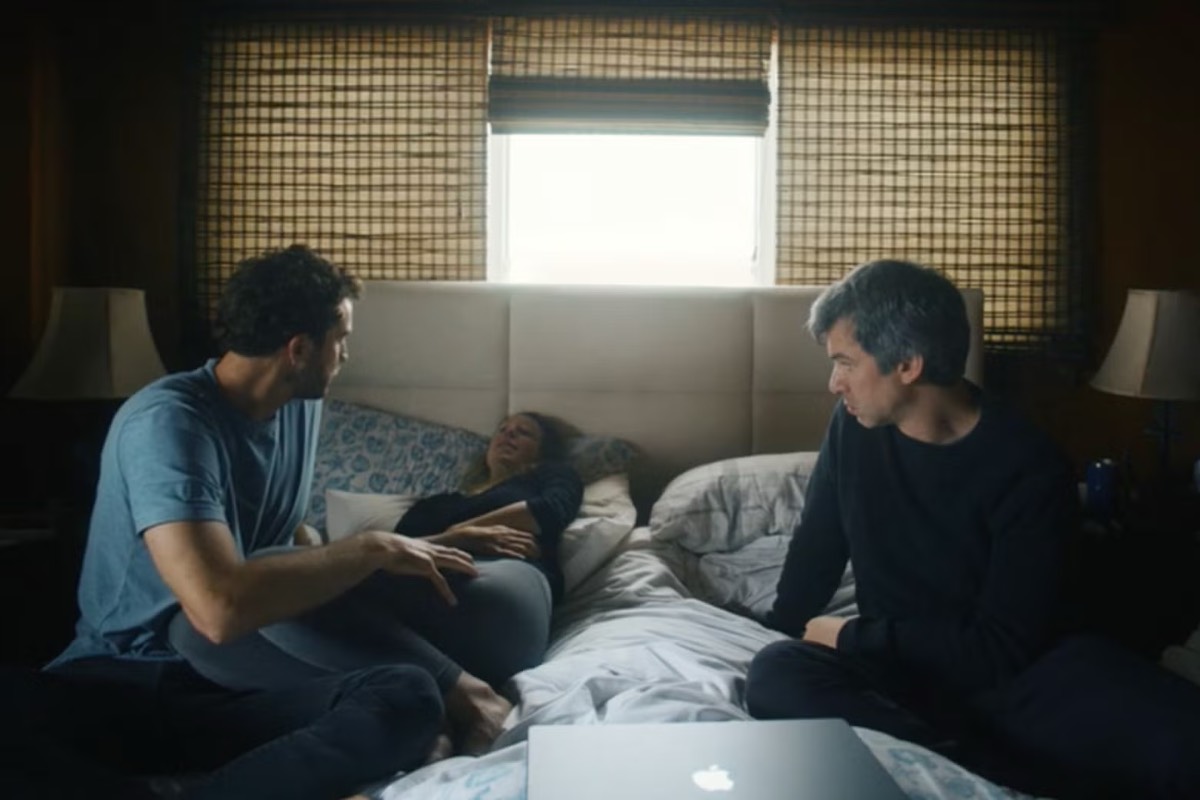
Fielder and Oppenheim don’t spend much time rehashing the Theranos debacle and Holmes’ subsequent trial and conviction, which is fine; that has been covered exhaustively elsewhere, including the Gibney documentary, and it’s not what they were interested in capturing. They’re more keen on the vibes than the facts. Holmes and Evans invited Fielder and the film crew to stay with them for the 34 days before her imprisonment, and given the strangeness of their initial interactions, Fielderbecamea major on-camera presence in the film.
The first half of the film is on the dull side, featuring lots of footage of Fielder and Holmesstaring at each other, unblinking, in an attempt to convince each other of their sincerity. (Jimmy Fallon and Jamie Lee Curtis hilariouslyspoofed this dynamicin a cold open forThe Tonight Show.) There is a tiresome segment quibbling over the relative meanings of the words “can” and “could.” Another segment dissects whether or not Holmes is capable of understanding the humor behind the classic “Who’s on First” sketch.
Fielder’s deadpan comedic style is used to good effect. Any laughs in that first half come from his reaction shots, such as his expression when Holmes insists, blue eyes extra wide, that she has never once lied in her entire life. And it’s just innately funny seeing him pop up again and again at the edges of the frame, like an awkwardly diffident stalker.
Much has been made of the scene where Evans insists Fielder film him working out at the gym—including a post-workout shower scene with Evansfaux-nonchalantly displaying side-frontal nudity. It’s nothing we haven’t seen before; HBO flashes its viewers all the time. Still, I can never unsee Evans’ flaccid junk, so thanks for that image being burned into my retinas, guys. But it fits the sleight-of-hand theme Fielder and Oppenheimer develop throughout the film. On the one hand, we are literally seeing everything. On the other, it is only the illusion of transparency, because Evans is so relentlessly squirrely and evasive—when not outright combative—about answering Fielder’s questions.
Frankly, Holmes and Evans just aren’t sufficiently interesting to carry a three-hour film, which is why Amanda Seyfried is such a breath of fresh air when she turns up for the second half to help Fielder and Oppenheim work around the physical absence of their primary subject. Seyfried plays Holmes in several carefully staged re-enactments—a fascinating window into the actor’s process—but she also becomes Fielder’s sounding board and (at times) co-conspirator. The film comes to life when she appears, akin to tossing a firecracker into a lackluster dinner party.
Seyfried, for instance, goads Evans into revealing that he has power of attorney and manages most activity on Holmes’ X account. She challenges Fielder about being reluctant to include footage that might show Holmes in a negative light because he’s come to care about her. And the film doesn’t let Seyfried off the hook either, forcing her to confront how her portrayal inThe Dropoutmight have been painful for Holmes, despite clearly being fictionalized to allow for taking a few liberties with the facts.
An “absurdist reality show”?
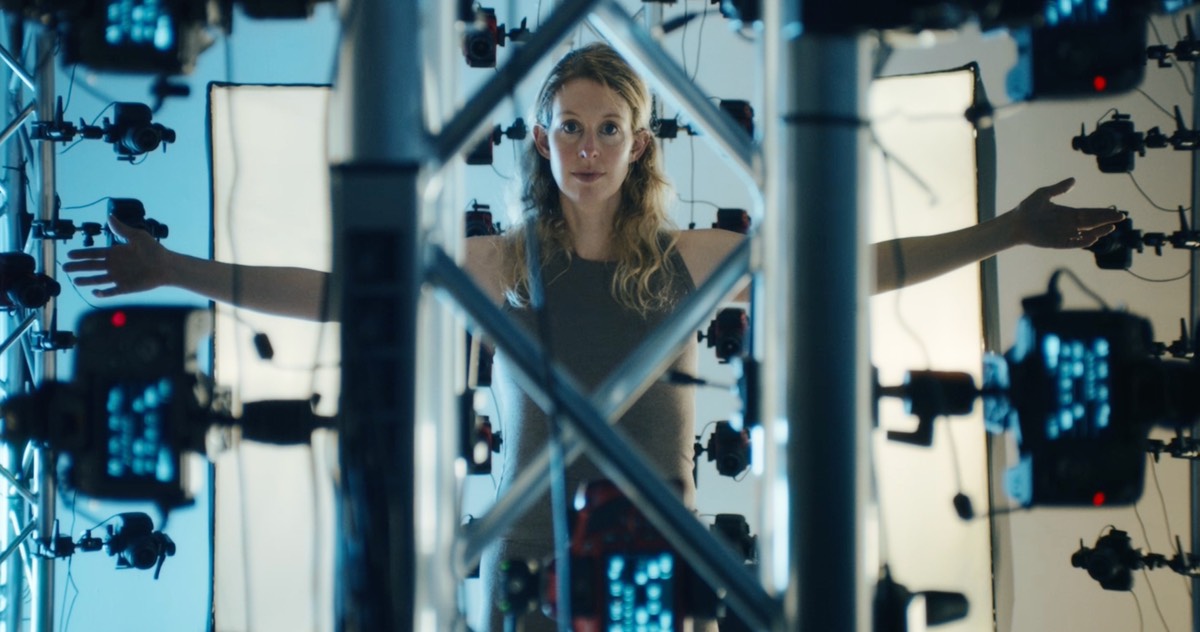
Holmes mid-body scan so an AI avatar can be used while she’s incarcerated
A24
Holmes mid-body scan so an AI avatar can be used while she’s incarcerated
A24
Holmes en route to federal prison to serve her sentence.
A24
Holmes en route to federal prison to serve her sentence.
A24
Holmes mid-body scan so an AI avatar can be used while she’s incarcerated
A24
Holmes en route to federal prison to serve her sentence.
A24
Ars Technica senior editor Sam Axon, who loved the film, describes it as “an absurdist reality show” or a “post-postmodern comedy rather than an interesting documentary” that is “more for fans of Nathan Fielder than for people interested in Theranos.” Fair enough. But it has been marketed as a documentary. That label carries certain expectations. Yes, Fielder and Oppenheim are deliberately (and skillfully) thwarting those expectations, but to what end? Savvy consumers already know that documentaries frame their subjects in specific ways. Gibney, for one, unapologetically makes documentaries that espouse his personal point of view, rejecting the so-called “view from nowhere”—i.e., the illusion of objectivity. And reality TV has been around for decades. We know it’s innately performative, and that cameras subtly alter human behavior, blurring the boundary between truth and fiction. This is not a novel insight.
Fielder makes a show of approaching his subject with an open mind in order to be more “objective,” but there are plenty of details that Fielder omits to better shape his preferred narrative. For instance,Evans claimedthey took a private jet to the Texas federal prison, whereas the film shows them driving there. More significantly, it’s clear Fielder deeply dislikes Evans (by the end of filming, the feeling was mutual), which is why he deliberately features moments that portray Evans as a controlling, manipulative, and almost comically vain Silicon Valley bro.
By comparison, Holmes is treated with kid gloves. This is not the smart, savvy, high-powered businesswoman who graced magazine covers and wowed tech reporters with her rosy vision of a diagnostic future free of anxiety-inducing blood draws. Even whistleblower Tyler Shultz has said this version of Holmes seems “broken.” But she’s still a very good liar.
Shultz points out inan articlefor STAT News that Holmes and Evans were living in the $125 million Green Gables estate just prior to filming. They moved to a smaller, average-looking rented condo on the beach for the duration of the shoot (which stillrents foraround $28,000 a month)—a strategy Holmes employed before when being profiled by journalists. And the disassembled Theranos blood testing device Holmes displays for the cameras—in the scene that triggered the “can” vs. “could” discussion—is not the correct device, per Shultz:
That was not the device I worked with 12 hours a day, not the device we hid from regulators, not the device that constantly failed quality controls, not the device we used to knowingly give patients inaccurate medical results. The device she showed Fielder on the kitchen table was not the reason she went to prison. Elizabeth showed him a future version of the Theranos product that was never completed and never used in order to lead Fielder down this BS semantic rabbit hole and to trick him into litigating the entirely wrong thing.
Did Fielder catch the misdirection? Was he taken in by the subterfuge, like so many before him? Or is he willfully ignoring those aspects because they don’t suit his purposes? I’ll take Gibney’s transparent subjectivity any day over Fielder’s ambiguous gamesmanship.
You Can See Everythingis obsessed with whether Holmes is lying, believes her own lies, or even understands what lying entails. Perhaps it’s not that black and white. I’m willing to grant that Holmes’ tears at having to leave her newborn child to serve her sentence are genuine; any mother would be heartbroken. But it also serves her broader purpose of crafting a more sympathetic narrative. The portrait that emerges is one of Holmes as the victim of yet another controlling, abusive man. It’s her entire legal defense during her trial, re-created here for Fielder’s (and our) benefit, with Evans taking on the scapegoat role of Holmes’ former business and romantic partner, Ramesh “Sunny” Balwani,currently servinga 12-year sentence for his part in the Theranos debacle.
Fielder has built his entire brand around theunreliable narratortrope, while Oppenheimhas been accused of misleadinghis subjects while making a 2017 short for The New York Times, so it’s fair to say both men might have a complicated relationship with the truth. Perhaps Holmes got the “documentarians” she deserved, and this is a match made in heaven. One can’t rule out the possibility that she and Evans were in on the game from the start and that the entire film is an elaborate performance piece, manufactured for our post-truth consumption: ‘Haha, look at these people trying to out-manipulate each other for the cameras, like contestants on the latest reality show.’ Are younot entertained?
The cynical nihilism of it all is exhausting, and ultimately the joke is on us. Facts matter. Accountability matters. Even in a world awash in deep fakes and misinformation, there are still some truths that can be known beyond a reasonable doubt, no matter how doggedly Fielder and Oppenheim try to muddy the waters. They want us to believe that Elizabeth Holmes is “unknowable and everything is ambiguous,” as Carreyrou—who, unlike me, loved the film and thinks it should win the Oscar for best picture—recently wroteon X. “She went after Tyler Shultz and Erika Cheung with everything she had. I was threatened with litigation on a daily basis for months on end. It was a ruthless cover-up of a breathtaking fraud, and she was at the controls. Just a little context for those who have forgotten or didn’t follow the original story.”
In the grand scheme of things, nobody cares what the science-and-culture writer at Ars Technica thinks about this film. I am firmly in the minority with my assessment, and I’m good with that. Oppenheim and Fielder will rake in box-office millions and collect a bunch of prestigious awards, including a possible Oscar. Holmes will serve her time—in fact, she’ll be eligible for a halfway house next year—and Evans is already hard at work raising capital for a new biomedical startup. Holmes will once again try to rehabilitate her image by spinning some new variation on how she did nothing wrong, the device really does work, and she is the victim here. It’s the only story she knows how to tell.
But we don’t have to keep falling for it.
You Can See Everythingis now playing in theaters.
Jennifer OuelletteSenior Writer
Jennifer OuelletteSenior Writer
Jennifer is a senior writer at Ars Technica with a particular focus on where science meets culture, covering everything from physics and related interdisciplinary topics to her favorite films and TV series. Jennifer lives in Baltimore with her spouse, physicist Sean M. Carroll, and their two cats, Ariel and Caliban.
24 Comments24 CommentsPrev storyNext story- 1.SpaceX no longer needs NASA, and that's a problem for America's space agency
- 2.Reddit is moving to “a logged-in-only experience,” CEO says
- 3.Microsoft fixes a Windows 11 annoyance as PC revenue declines
- 4.China's top-secret spaceplane can't hide in low-Earth orbit
- 5.Massive leak exposes 41,000 DHS workers and undercover ICE agents