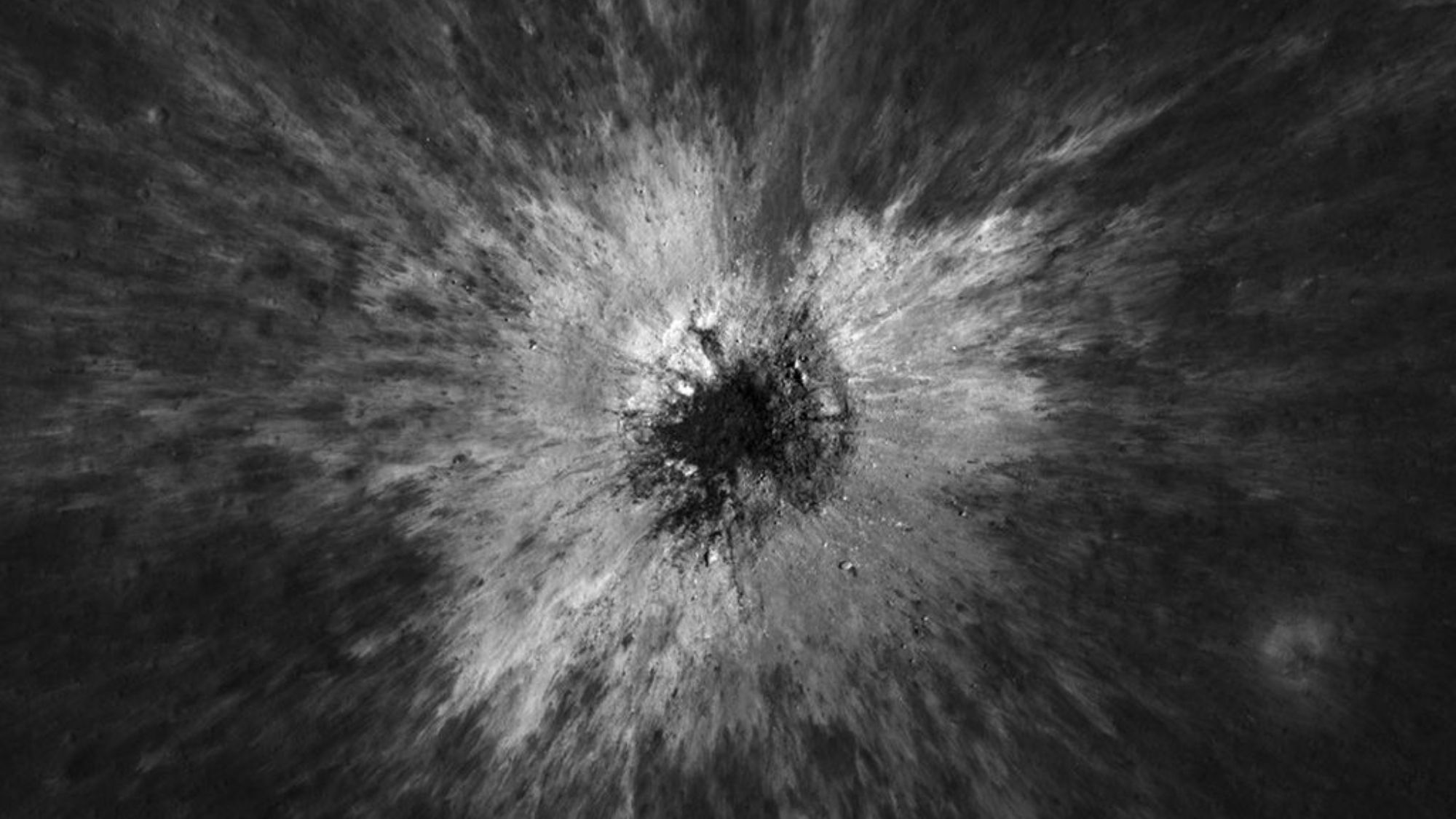
NASA's moon-orbiting spacecraft, the Lunar Reconnaissance Orbiter (LRO), has captured a fresh new crater on our moon — and this cavity is so huge scientists call it a "once-in-a-century" discovery.
What is it?
What you see in this image is an aerial view ofMcGetchin crateronthe moon. Named after Tom McGetchin, a lunar scientist whose tenure fell during theApolloera, the crater measures out at 728 feet (221.9 meters) wide and 141 feet (43 meters) deep.
The image was captured by theLunar Reconnaissance Orbiter's (LRO) Narrow-Angle Camera on Dec. 5, 2025 and covers about 0.75 miles (1.2 kilometers) of width on the moon. The crater itself, however, was originally discovered on Oct. 24, 2025 by LRO scientist Robert Wagner. Serendipitously, Wagner happened to identify the feature during a routine data-quality check of his data. "I just stopped, dropped everything, and started looking into what that spot was," he said in astatement.
Latest Videos From
Space
View moreWatch full video here:
Scientists believe this huge crater formed in 2024, at some point between April 11 and May 22. They also think the asteroid (or perhaps comet) that smashed into the moon and formed the crater should have been about the size of a three- to six-story building.
Why is it incredible?
The reason McGetchin is dubbed a "once-in-a-century" crater has to do with its massive size. This dent in the moon is actually the largest newly formed crater ever found on our lunar companion — and, in fact, in the entire solar system.
According to NASA, the enormous lunar impact that could have formed a crater with such heft should only happen about once every hundred or so years. Some scientists have even authoreda paperthat delves into studying the buckets of lunar material that would've been thrown outward as the impact happened; another team looked at how the region around the craterwas altereddue to the crash.
As to why it's so exciting to investigate a freshly formed crater? Well, it's basically because enough time hasn't yet passed to degrade the scene of the crime. Over time, geologic features slowly change due to exposure to the elements — even on the moon, where time seems to stand still. So, scientists are getting a rather pristine crash site to analyze. And though tons of other bits and bobs hit the moon every year, they either don't form a crater visible to LRO or lead to a very small one.
Last year, for example, LRO found a crater large enough to make the news — but it was so little scientists adorablycalled ita "freckle." It has surely been overshadowed by this brand new lunar beauty mark.
Astronomy Channel Editor
Monisha Ravisetti is Space.com's Astronomy Editor. She covers black holes, star explosions, gravitational waves, exoplanet discoveries and other enigmas hidden across the fabric of space and time. Previously, she was a science writer at CNET, and before that, reported for The Academic Times. Prior to becoming a writer, she was an immunology researcher at Weill Cornell Medical Center in New York. She graduated from New York University in 2018 with a B.A. in philosophy, physics and chemistry. She spends too much time playing online chess. Her favorite planet is Earth.
You must confirm your public display name before commenting
Please logout and then login again, you will then be prompted to enter your display name.