Sign in
Welcome! Log into your account
Forgot your password? Get helpPrivacy PolicyPassword recovery
Recover your password
A password will be e-mailed to you.
GEN – Genetic Engineering and Biotechnology NewsHomeTopicsBioprocessingLarge Bioprinted Tissues Get a Precision Boost
Credit: Image generated with Google Gemini
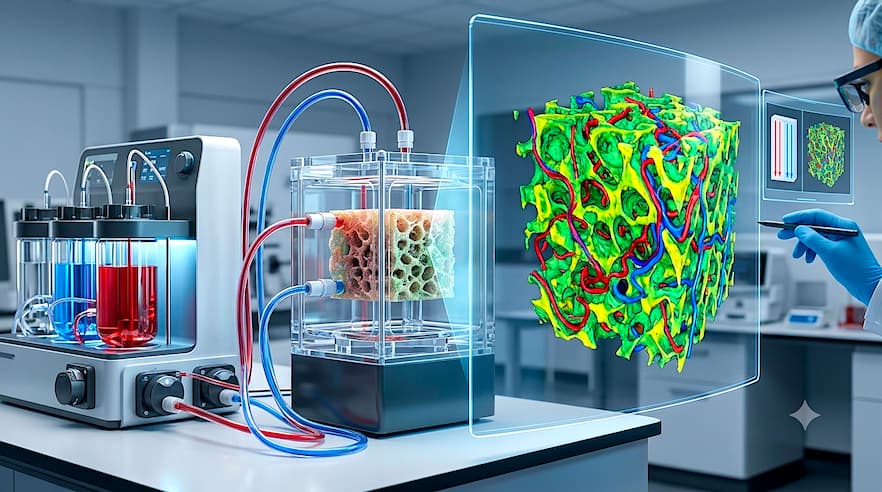
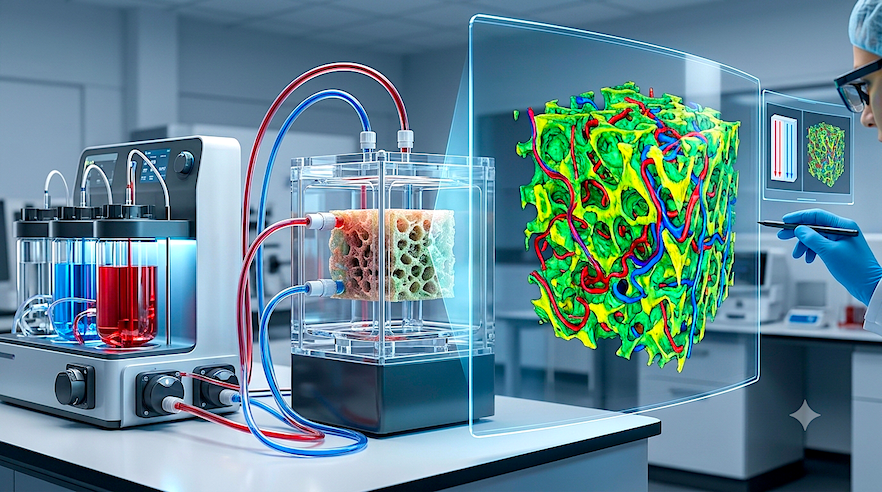
Improving the cultivation of large bioprinted tissues could help make laboratory-grown tissue models more reliable for drug development and regenerative medicine. At the International Society for Cell & Gene Therapy (ISCT) 2026 annual meeting in Dublin, Elliot Cowles, a doctoral student in bioprocess engineering at Université Claude Bernard Lyon 1, and colleagues presented aperfusion-based culture system, which was described inCytotherapy, that addresses this challenge. Although biofabricated tissues are increasingly used forin vitroresearch, many remain relatively small and are typically grown under static conditions that limit scalability and consistency.
The team’s approach combines custom-designed, 3D-printed components with an Ambr250 bioreactor to maintain tightly regulated culture conditions. The researchers validated the custom parts as autoclavable and leak-proof before using them to support an 8-cm2macroporous bioprinted tissue. Culture medium was continuously pumped through the tissue at 1.5 mL/min while the bioreactor regulated oxygen levels, temperature, and pH.
To better understand what was happening inside the tissue without damaging it, the researchers used high-resolution magnetic resonance imaging. The scans reconstructed the tissue’s three-dimensional structure and tracked how fluid moved through it. Rather than flowing uniformly, the liquid followed uneven pathways that differed from computer-aided design predictions, revealing a more complex internal environment than expected.
Over a 21-day culture period with this platform, temperature, dissolved oxygen, and pH remained stable across a broad range of oxygen settings. The team did detect a consistent difference between oxygen levels measured in the regulation vessel and those reaching the tissue chamber, but traced the discrepancy to oxygen entering the culture medium through flexible tubing. Still, the researchers successfully perfused three large mesenchymal stem cell–based tissues using minimal culture medium.
Cowles and his colleagues concluded that the new platform provides a controlled environment for cultivating larger bioprinted tissues while offering detailed, non-destructive monitoring of internal flow patterns. Looking ahead, they plan to improve quantitative flow measurements and develop computational fluid dynamics models capable of mapping local tissue microenvironments, with the goal of advancing reproducible large-scale tissue maturation.
InsightsBioprintingBioreactorCulture mediaDrug development (Research and development)Magnetic resonance imagingRegenerative medicineAlso of Interest
Smarter Cell Culture Starts with Better MediaCAR T Manufacturing in Japan Gets Boost from Teijin-Shinshu University Research CollaborationRevvity Signs Agreement to Acquire Human Cell DesignTop 10 Contract Development and Manufacturing Organizations 2026Harnessing Real-Time DataRegenerative Medicine in the Bronze Age: MSCs and MSC-EVs Leading the WayRelated Media
Small Molecules, Big Expectations: How CDMOs Are Helping Sponsors Navigate Complexity, Speed, Scale-Up, and SustainabilityReporting Live from JPM 2026: Alex Philippidis and Jonathan Grinstein, PhDWhat’s in Store for 2024? Three CEOs Look Ahead and Look Back on “Close to the Edge”Excitement in Oakland: A Report from SynBioBetaBIO CEO Rachel King Outlines Industry's Challenges on "Close to the Edge"Decoding Genomic Diversity with deCODE Genetics CEO Kári Stefánsson on "Close to the Edge"Top 5ResourcesRecommended For YouPodcast
Touching Base
Touching Base is the dynamic podcast series from the editors ofGEN. Each episode features a rotating case of senior editors—including John Sterling, Kevin Davies, Julianna LeMieux, Alex Phillippidis, Uduak Thomas, Corinna Singleman, and Fay Lin—who delve into emerging stories, exchange ideas, and debate the latest trends in biotech. Additionally, they talk to some of the leading voices in the industry about what's now and next.Start listening today!
Stay up to date with the lasted episodes of Touching Base bysubscribing to theGENPodcast Newsletter
Copyright © 2026 Sage Publications or its affiliates, licensors, or contributors. All rights reserved, including those for text and data mining and training of large language models, artificial intelligence technologies, or similar technologies.
MORE STORIES