Sign in
Welcome! Log into your account
Forgot your password? Get helpPrivacy PolicyPassword recovery
Recover your password
A password will be e-mailed to you.
GEN – Genetic Engineering and Biotechnology NewsHomeTopicsArtificial IntelligenceAI Protein Engineering Model Designed for Biomanufacturing
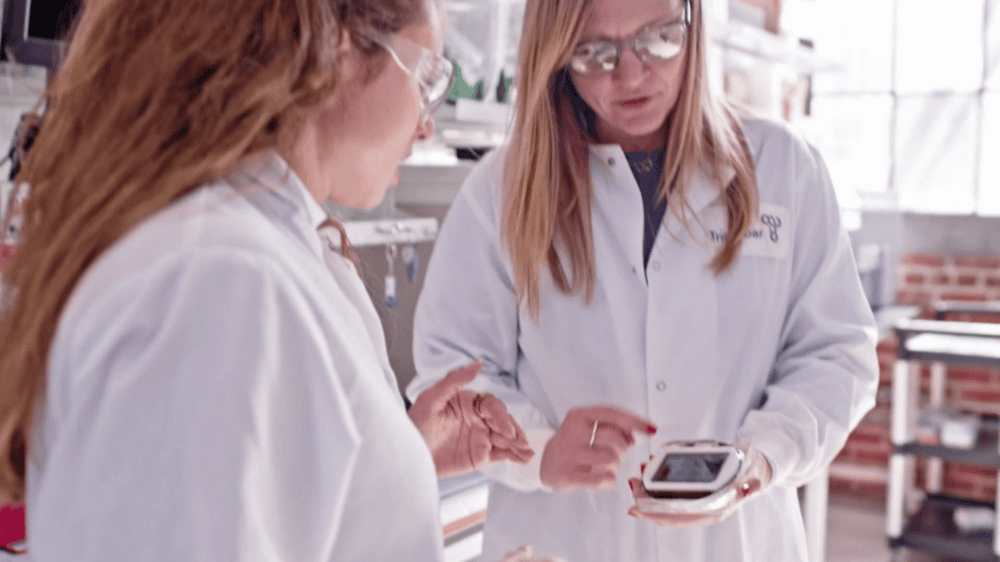
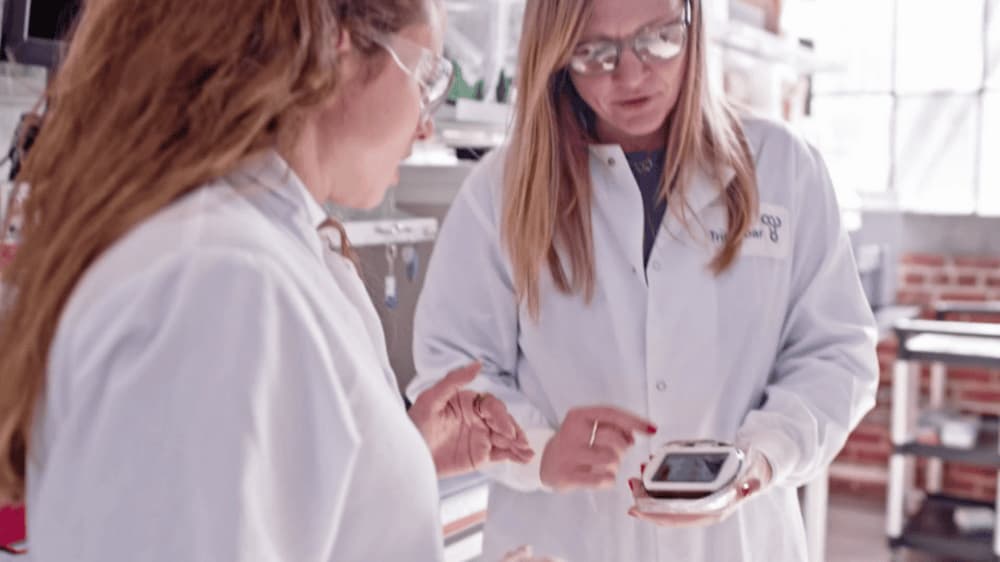
Researchers with Triplebar Bio’s droplet microfluidics chip [Triplebar Bio]
A cell engineering model designed specifically for the biomanufacturing environment could go a long way toward optimizing host cell performance, reducing development timelines, and streamlining biomanufacturing platform design.
“There’s a real challenge in determining how to engineer a host cell’s genome to maximize its performance in a biomanufacturing application.” That’s the difficulty laid out by Shawn Manchester, PhD, CEO, Triplebar Bio, and a view that’s shared by Yun Song, PhD, professor, University of California, Berkeley, and the industry innovation organization BioMADE. The three, with support from the National Science Foundation, are developing such an AI-informed cell engineering model to solve that challenge.
What’s most notable is that this AI-informed predictive and optimization model focuses on the biomanufacturing environment. The large-scale, application-specific training database is being designed to handle bench- to commercial-scale biomanufacturing.
Biomanufacturing-relevant environment
As Manchester says, “There aren’t a lot of organisms that have naturally evolved to make proteins they’ve never seen before, in an environment they’re not well-evolved for. Our ability to generate data in a setting that is relevant to biomanufacturing and to do so at the scale of hundreds of thousands of cells and data points is innovative…and it’s not something that many others are looking at. Most people are working on AI for protein engineering of therapeutics and other molecules as opposed to cell engineering for use in biomanufacturing.”
This project focuses on data capture fromPichia pastorisas the host cell producing five different proteins that are relevant for bioprocessing, food production, and defense. The learnings will be incorporated into Triplebar’s other programs, too, including optimization for its Chinese hamster ovary (CHO) cells, Manchester says.
“Improving the scalability of these proteins directly benefits [not just bioindustrial or biopharmaceutical applications, but a broad range of] biomanufacturing,” Brandon Simmons-Rawls, program manager, BioMADE, emphasizes.
This AI project combines two core technologies deployed at Triplebar:
- Droplet microfluidics, in which a cell is encapsulated in a water and oil emulsion alongside a fluorescent-based sensor to quantify protein production
- Multimodal transformer-based AI model
The genomes and transcriptomes of cells that make either more or less protein than baseline are sequenced and fed into the AI’s very large, labeled training sets to identify correlations between genotypes and phenotypes. These correlations are important patterns about how the genome works, Manchester explains, and can be used to generate new genomic designs for optimization of the host cell to the biomanufacturing process.
“We first pre-train models on all relevant sequencing data from thousands of genomes, which gives us an underlying structure to the genome. Then we fine-tune those models with the genotype-phenotype data we generate in the biomanufacturing-relevant environment. This allows us to understand which of those patterns in the genome relate to biomanufacturing-specific performance,” Manchester says.
Once this AI-enabled model rolls out, Manchester says he envisions it being used by bioindustrial and biopharma companies that “need to improve the productivity or efficiency of the organism they use in manufacturing. Results should be faster and more efficient than those derived using guess-and-check methods based on our current understanding of how these organisms work.
“The goal is for people to log onto this AI tool, identify what they’re making and what they’ve done, and ask the AI what else they can do to improve performance,” he continues. “The model will serve them specific genetic designs that they can deploy in their organism.”
Manchester predicts that more than 10% of the designs will produce meaningful improvements—significantly more than traditional, early-stage design-build-test cycles. This streamlines the cell engineering cycle by focusing on modifications likely to yield performance improvements that are most meaningful for biomanufacturing.
InsightsArtificial intelligenceBiomanufacturingGenotypeMicrofluidicsPhenotypeProtein engineeringStem cell engineeringAlso of Interest
Bone Marrow-on-a-Chip Model Offers New Window Into Immune Cell Development and BehaviorCloudScope Enables Continuous Remote Monitoring of Brain Activity in Freely Moving MiceManus and UT Austin Advance Biomanufacturing Product Recovery Through BioMADE ProgramSmarter Cell Culture Starts with Better MediaRevvity Signs Agreement to Acquire Human Cell DesignTop 10 Contract Development and Manufacturing Organizations 2026Related Media
Data Integrity as the Foundation for AISmall Molecules, Big Expectations: How CDMOs Are Helping Sponsors Navigate Complexity, Speed, Scale-Up, and SustainabilityBeyond the Technology: AI Readiness in Regulated LaboratoriesAACR 2026 Video Update: Cancer Research Edges Toward an AI-Driven EraReporting Live from JPM 2026: Alex Philippidis and Jonathan Grinstein, PhDAI in Protein Design: Hype vs. Reality Explained by David BakerTop 5ResourcesRecommended For YouPodcast
Touching Base
Touching Base is the dynamic podcast series from the editors ofGEN. Each episode features a rotating case of senior editors—including John Sterling, Kevin Davies, Julianna LeMieux, Alex Phillippidis, Uduak Thomas, Corinna Singleman, and Fay Lin—who delve into emerging stories, exchange ideas, and debate the latest trends in biotech. Additionally, they talk to some of the leading voices in the industry about what's now and next.Start listening today!
Stay up to date with the lasted episodes of Touching Base bysubscribing to theGENPodcast Newsletter
Copyright © 2026 Sage Publications or its affiliates, licensors, or contributors. All rights reserved, including those for text and data mining and training of large language models, artificial intelligence technologies, or similar technologies.
MORE STORIES