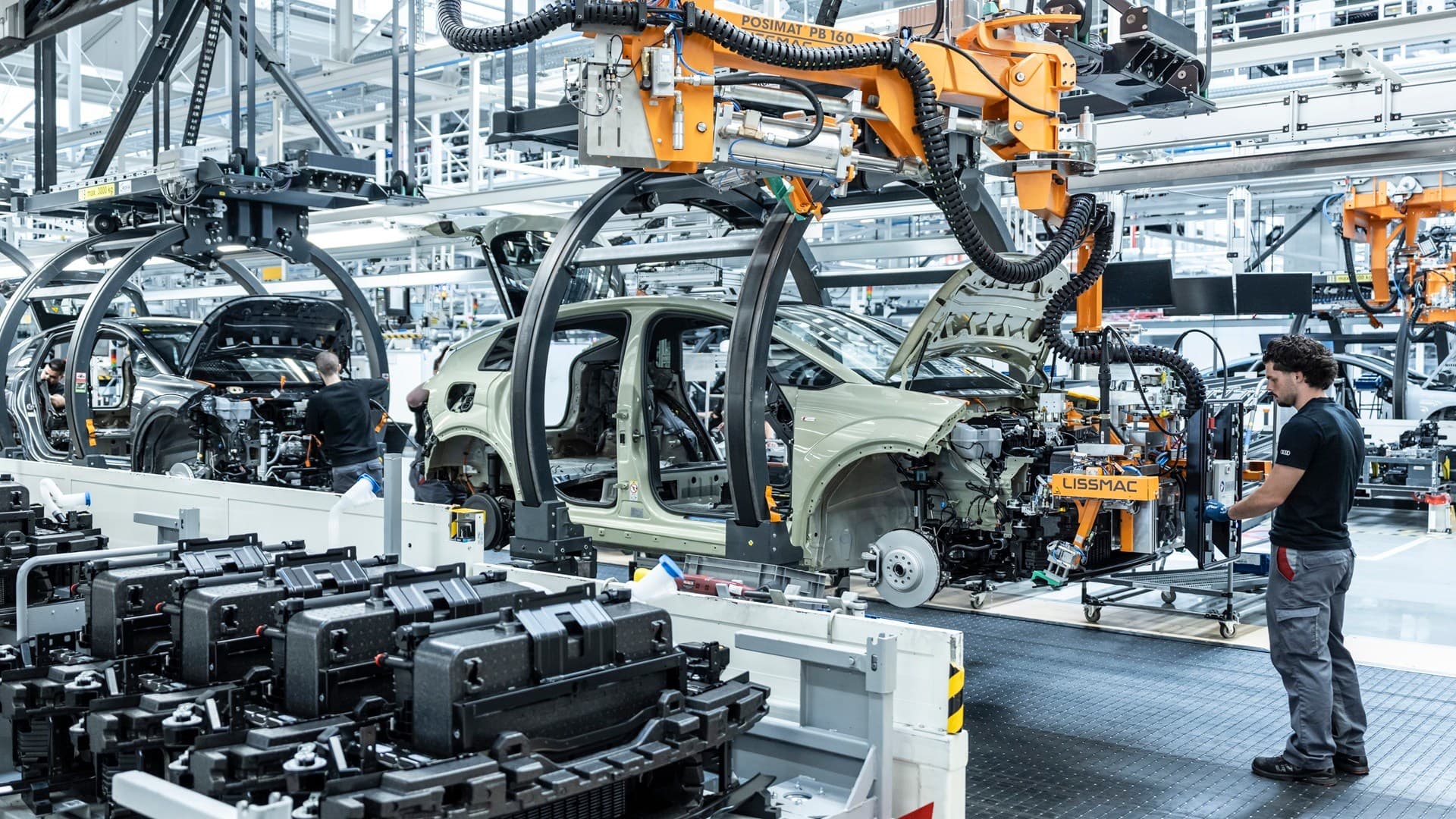
Luxury carmaker Audi has recently started building its fully electric A2 e-tron at its Ingolstadt production plant in Germany, after reducing the vehicle’s development time by a total of 21 months.
The Bavarian automaker stressed that the A2 e-tron, considered the most efficient Audi of all time, is intended for the European market. The model reportedly marks a major shift in the company’s approach to developing and building cars.
Forthe new model, the firm reused and repurposed more than 1,200 production components. These include approximately 250 robots that were previously used to manufacture other Audi vehicles.
In addition, Audi also introduced AI assistants, cloud computing,camera-guided robots, and fully automated wheel installation. The technologies are intended to make the production operations faster, simpler, and cheaper. “The Audi A2 e-tron represents the next step in our renewal,” Gernot Döllner,Audi CEO, elaborated. “It shows how we consistently think from the market backward, because different regions need different answers.”
Reusing old parts
As part of its new production strategy, the company reused or repurposed over 1,200 production parts, rather than investing in entirely new equipment. These, according to the carmaker, include robot welding guns and around 250 robots that previously worked on other Audi models. The approach allows the firm to use its existing factory equipment to design the EV instead of installing new machinery. "Bavaria knows cars: Production of Audi's new A2e-tronhas begun at Audi's beating heart in Ingolstadt," Markus Söder, Bavaria's Minister-President, said.
Two cars, one line
Both the bodies of the A2e-tronand the Audi A3 will be manufactured together on the same production line. Audi said this is possible due to the flexible factory layout. Sharing equipment between different models gives the automaker greater flexibility as its vehicle lineup increasingly shifts toward electric powertrains. "The start of production of the Audi A2e-tronis the result of extensive teamwork at the Ingolstadt plant," Siegfried Schmidtner, Audi Ingolstadt plant manager, emphasized. "Production of the new model strengthens core capabilities at our headquarters."
Wheel fitting goes automatic
The A2 e-tron also brings fully automated wheel installation to Audi's Ingolstadt factory. Instead of workers relying on partly automated machines, robots can now handle the entire process of fitting and securing the wheels. Audi is also using automation elsewhere in the production process. The company said the technologies are intended not only to increase efficiency but also to reduce physically demanding work for the employees.
Robots find and pick parts
Meanwhile, bin picking is yet another technology that Audi introduced for the A2 e-tron. The approach combines cameras and image processing. It can also recognize and pick up components, and reduce physically demanding tasks. What's more, for the first time, robots can also pick small sheet-metal parts from mixed containers and move them to the next production stage.
Cloud replaces 450 factory PCs
In addition, the company has changed the computing process behind assembly operations. Its industrial Edge Cloud 4 Production system centrally controls applications for A2 e-tron manufacturing. These include the Universal Test System, which commissions the vehicle's control units, and an operator-guidance system that provides data concerning individual vehicle configurations. By moving these functions to its cloud infrastructure, Audi revealed that it can eliminate the need for over 450 industrial PCs across assembly operations.
New factory workers
At the same time, the automaker introduced AI assistants across its production sites to give employees quicker access to information. One example is the Supply Chain Chatbot, which can help workers search for expert knowledge, documentation, and details about different manufacturing processes. A separate maintenance assistant can support teams to analyze faults and search for potential solutions. Gerd Walker, Audi board member for production and logistics, said the A2 e-tron shows cars can still be built profitably in Germany. "Particularly important in this regard are AI assistants developed jointly by our Neckarsulm and Ingolstadt sites, our highly flexible production facilities, and, above all, the expertise of our employees," Walker added.
Accelerating development
According to Audi, the A2 e-tron reached readiness 21 months faster than previous vehicles. "We are particularly proud of this as the works council, because together with the workforce we have repeatedly fought with great determination since 2019 for Audi to develop an entry-level electric model and build it in Ingolstadt," Jörg Schlagbauer, Audi General Works Council chairman, concluded. Audi has also reduced the number of production-relevant parts and adopted a string-of-pearls production principle. Customer orders are placed into a fixed sequence six days before assembly begins.