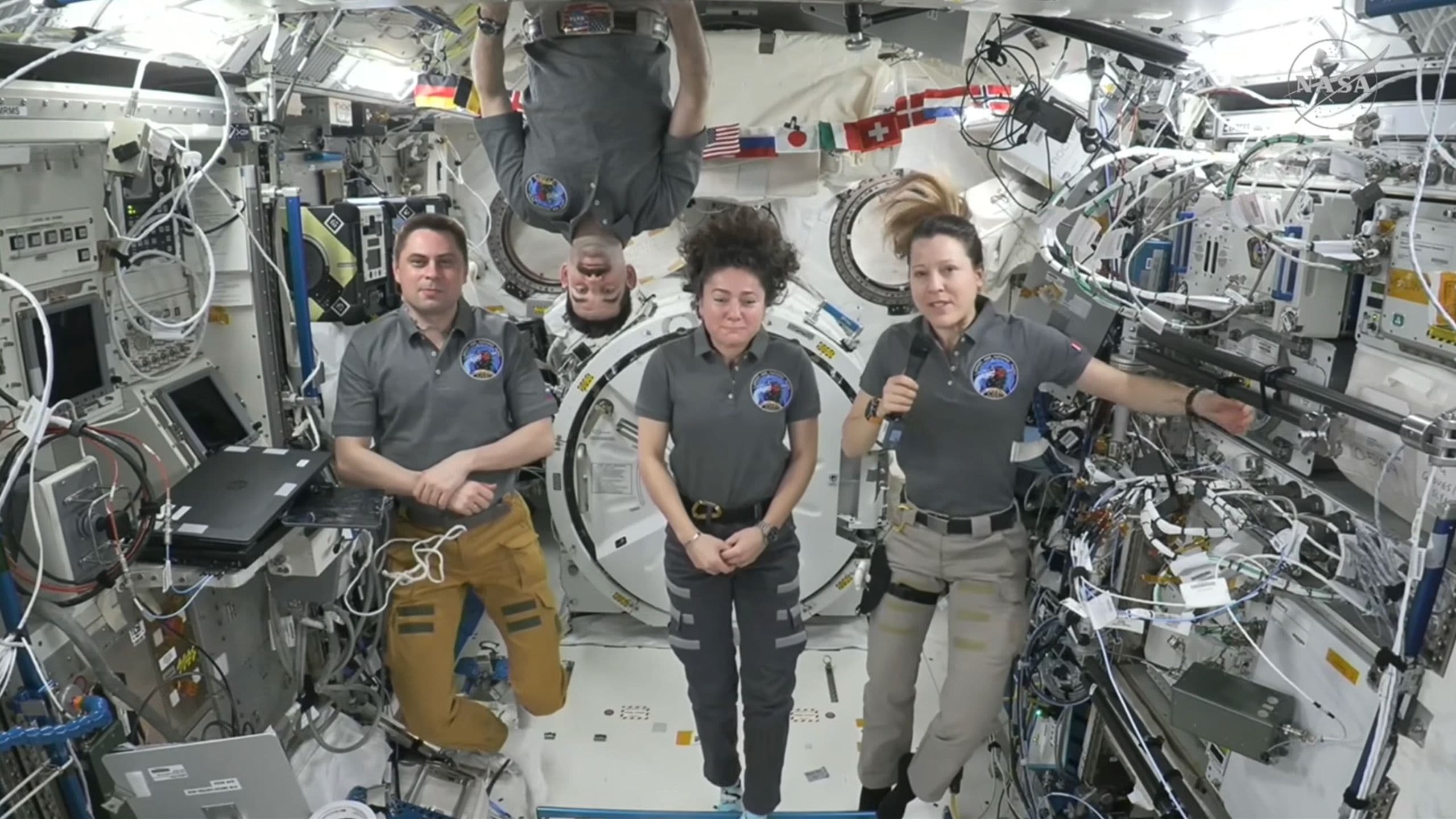
Europe's prototype spacesuit aboard the International Space Station (ISS) still needs some work afterEuropean Space Agencyastronaut Sophie Adenot performed its first fit and dexterity checks on orbit.
EuroSuit launched aboard theSpaceXCRS-34 Cargo Dragon mission, which lifted off May 15 and docked to theISSabout two days later with nearly 6,500 pounds (2,950 kilograms) of supplies and equipment. Adenot arrived on the ISS three months earlier, in February, as a member of the SpaceXCrew-12 mission. Her time with the suit gave European engineers their first astronaut feedback on the intravehicular activity (IVA) prototype in orbit, and she did not give a five-star review.
"I think there are still a lot of points that will be improved in the future," Adenot told Space.com on Sept. 16, during a call with reporters previewing the Crew-12 mission'simpending return to Earth. "We are looking forward to the future steps."
EuroSuit was developed by the French Space Agency (CNES), the Institute of Space Medicine and Physiology (MEDES), spaceflight systems company Spartan Space, and sports clothing brand Decathlon. As the "I" in IVA suggests, EuroSuit is not designed forspacewalks. It's meant for use inside a spacecraft during the most critical phases of flight, specifically launch and landing, similar to the black-and-white spacesuits worn by astronauts who launch aboard SpaceX'sCrew Dragon.
One of the suit's biggest innovations is supposed to be its ease of use. EuroSuit is designed for astronauts to put on, without help from another crewmember, in less than two minutes, and take off in the same amount oftime. This would be a big advantage in emergency situations when astronauts may need to don their suits quickly — for example, to deal with a spacecraft pressure leak or to evacuate the space station.
Adenot's on-orbittests focused on the ergonomicsof the suit, rather than full life-support performance. She was tasked with donning and doffing the suit and assessing its dexterity by handling small objects and manipulating a tablet's touchscreen.
EuroSuit fits into a broader European effort to build more independent capabilities in space. CNES says the project reflects Europe's ambition to be more autonomous in human spaceflight, with the French space agency focusing specifically on intravehicular suits.
"By relying on the exceptional expertise of our partners, we are prepared to deliver this type of suit when the time comes," Sébastien Barde, CNES deputy director for exploration and human spaceflight, saidin a statementlast year.
The project is coordinated by CNES, which brought together the aerospace, medicine and activewear expertise that went into EuroSuit's development. Spartan Space, the suit's primary contractor, created the overall design, with MEDES contributing biomonitoring systems for tracking astronaut vital signs and other data. Decathlon brought ergonomic insight into textiles meant for extreme environments.
Feedback from Adenot's ISS tests will help guide EuroSuit technicians toward a more informed architecture, which will include key systems like pressurization, atmospheric control, and communications that will be needed for the final design.
"This EuroSuit is at the very first step of its development," Adenot said. "Everything in the design ofspacesystems goes incremental. I would say right now we are at the very beginning of its journey."
Staff Writer, Spaceflight
Josh Dinner is Space.com's Spaceflight Staff Writer. He is a writer and photographer with a passion for science and space exploration, and has been working the space beat since 2016. Josh has covered the evolution of NASA's Artemis program and humanity's return to the moon, commercial spaceflight partnerships and crewed missions from the Space Coast, NASA science missions and more. He also enjoys building 1:144-scale model rockets and spacecraft. Find some of Josh's launch photography onInstagram, and follow himon X, where he mostly posts in haiku.
You must confirm your public display name before commenting
Please logout and then login again, you will then be prompted to enter your display name.