Premium
Follow
How stacked solar panels work
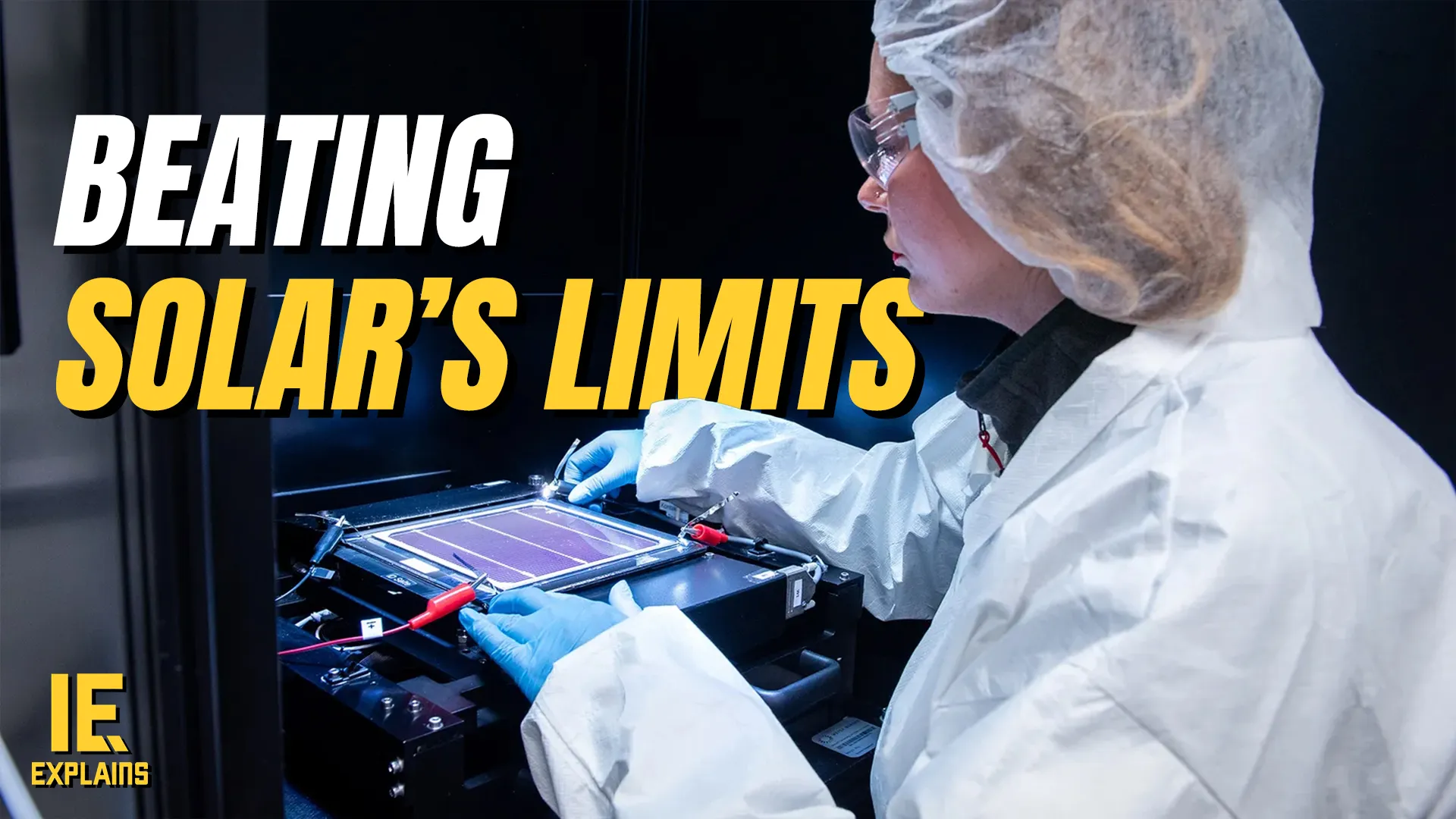
InnovationGet your news fromINTERESTING ENGINEERINGOxford PV shipped the first commercial stacked solar panels in September 2024, silicon cells coated with a few hundred nanometres of perovskite that harvests the blue light silicon wastes as heat.
In a factory in Brandenburg an der Havel, an hour west of Berlin, a company called Oxford PV takes ordinary silicon solar cells and coats a second solar cell on top of them. The upper layer is a crystal called perovskite, only a few hundred nanometres thick—thinner than a soap bubble. Its job is to capture the part of the sunlight that silicon has always discarded as heat.
In September 2024, Oxford PV shipped the first commercial batch of these tandem panels to a customer in the United States. The 72-cell panels were 24.5% efficient—a modest figure in the laboratory, but they were the first stacked solar panels ever sold for a real project. So, what exactly are these panels, and why is the entire industry—from Chinese giants to California startups—moving in this direction now?
Sunlight arrives as photons carrying a broad range of energies, from ultraviolet through visible light to infrared. A solar cell made from a single material can respond to that energy in only one way. Silicon’s bandgap is about 1.1 electronvolts, the minimum energy a photon needs to knock an electron loose. Photons weaker than that pass straight through without doing anything, while much stronger photons free an electron but lose their excess energy as heat inside the wafer.
ADVERTISEMENT
RECOMMENDED VIDEOS
InnovationTransparent Differential Cover Demonstration
3 months ago
InnovationPrestressing Steel Tendons
3 months ago
InnovationScrew Conveyor Gravel Loader
3 months ago
InnovationThis Logging Machine Fells and Strips a Tree in Seconds
3 months ago
InnovationNASA Crash-Tests a Lightweight Helicopter to Study Spine-Crushing Impact Forces
2 months ago
InnovationThese guys are building Atomarine — Floating, Nuclear-Powered Data Centers
2 months ago
InnovationTesting the Limits of Human Reaction Speed
3 months ago
Innovation100 Billion Transistors Fit on a Chip the Size of Your Fingernail
3 months ago
InnovationPumping Concrete Through a Heavily Reinforced High-Rise Foundation in Vancouver
2 months ago
InnovationThis Tool Seals a Leaking Pipe in Seconds Without Shutting Off Flow
3 months ago
Transparent Differential Cover Demonstration
3 months ago
InnovationPrestressing Steel Tendons
3 months ago
InnovationScrew Conveyor Gravel Loader
3 months ago
InnovationThis Logging Machine Fells and Strips a Tree in Seconds
3 months ago
InnovationNASA Crash-Tests a Lightweight Helicopter to Study Spine-Crushing Impact Forces
2 months ago
InnovationThese guys are building Atomarine — Floating, Nuclear-Powered Data Centers
2 months ago
InnovationTesting the Limits of Human Reaction Speed
3 months ago
Innovation100 Billion Transistors Fit on a Chip the Size of Your Fingernail
3 months ago
InnovationPumping Concrete Through a Heavily Reinforced High-Rise Foundation in Vancouver
2 months ago
InnovationThis Tool Seals a Leaking Pipe in Seconds Without Shutting Off Flow
3 months ago


