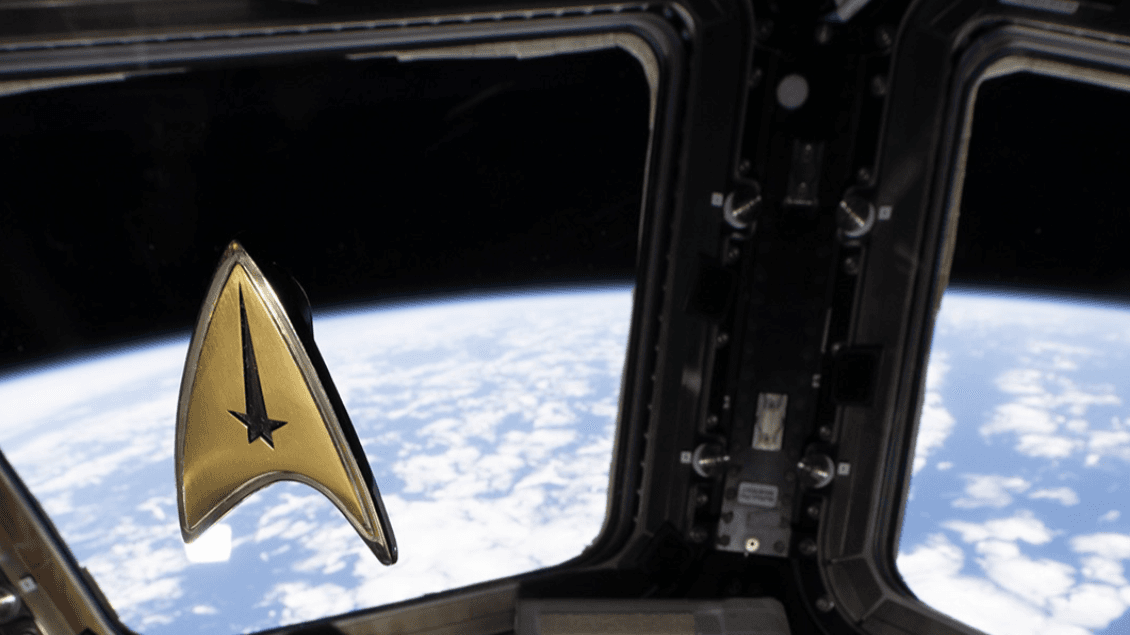
Celebrations of Star Trek's 60th anniversary made it all the way to the final frontier.
Among the science and supplies delivered to theInternational Space Station(ISS) forEuropean Space Agency(ESA) astronaut Sophie Adenot's mission on orbit was a small piece of memorabilia to honor one of the most influential pop culture phenomena that has continually called for humanity to turn its gaze to thestars. Adenot carried a small Starfleet badge from one of Star Trek's newest series, Strange New Worlds, which she wore during avideo posted by ESA and Star Trek.
"It's a small object, but it carries something bigger: sixty years of a story that taught us to dream about exploring together," ESA said in a separatepost picturing the golden badgefloating in front of the station's large Cupola windows. "From the crew of the USS Enterprise to the crews on the International Space Station, the mission hasn't really changed. Explore. Discover. Do it together," the post says.
Adenotlaunched to the ISSaboard aSpaceXDragoncapsule onNASA's Crew-12 mission to the orbital lab on Feb. 13, and is serving as flight engineer for ISS Expedition 75. It's her first launch tospace, and is set to wrap up soon, pending the launch and arrival of SpaceX's next Dragon spacecraft carrying the astronauts of NASA's Crew-13 mission, expected within just a few weeks.
In Adenot's video, she is seen donning the Starfleet badge on her ESA-issue ISS shirt, floating in ESA's Columbus laboratory module. "For me, exploration and science are about curiosity and cooperation, daring to go a little farther together, learning from what we discover and build, and turning that knowledge into a better future for everyone," she said.
Star Trek, too, has resonated with similar themes. Since its premiere on Sept. 8, 1966, the show has told stories that place social issues and cultural conflicts front and center in a way that 'demonstrates the best traits of humanity. It depicts, in its creator Gene Roddenberry's view, an idyllic version of humanity he believed was truly achievable through the act of simply accepting one another.
A post shared by Star Trek (@startrek)
A photo posted by on
"The whole show was an attempt to say that humanity will reach maturity and wisdom on the day that it begins not just to tolerate, but to take a special delight in differences in ideas and differences in life forms," Roddenberry said in the 1976 album The Star Trek Philosophy. "If we cannot learn to actually enjoy those small differences — take a positive delight in those small differences between our own kind — here on this planet, then we do not deserve to go out into space and meet the diversity that is almost certainly out there."
ESA celebrated that philosophy, and the potential it holds for humanity. "Science fiction imagines the future. We build it," ESA's post said. "From the crew of the USS Enterprise to the crews on the International Space Station, the mission hasn't really changed. Explore. Discover. Do it together."
Watch Star Trek Strange New Worlds on Paramount+:
Essential (ads):$8.99/mo or $89.99/yr
Premium (no ads):$13.99/mo or $139.99/yr
You must confirm your public display name before commenting
Please logout and then login again, you will then be prompted to enter your display name.
Staff Writer, Spaceflight
Josh Dinner is Space.com's Spaceflight Staff Writer. He is a writer and photographer with a passion for science and space exploration, and has been working the space beat since 2016. Josh has covered the evolution of NASA's Artemis program and humanity's return to the moon, commercial spaceflight partnerships and crewed missions from the Space Coast, NASA science missions and more. He also enjoys building 1:144-scale model rockets and spacecraft. Find some of Josh's launch photography onInstagram, and follow himon X, where he mostly posts in haiku.