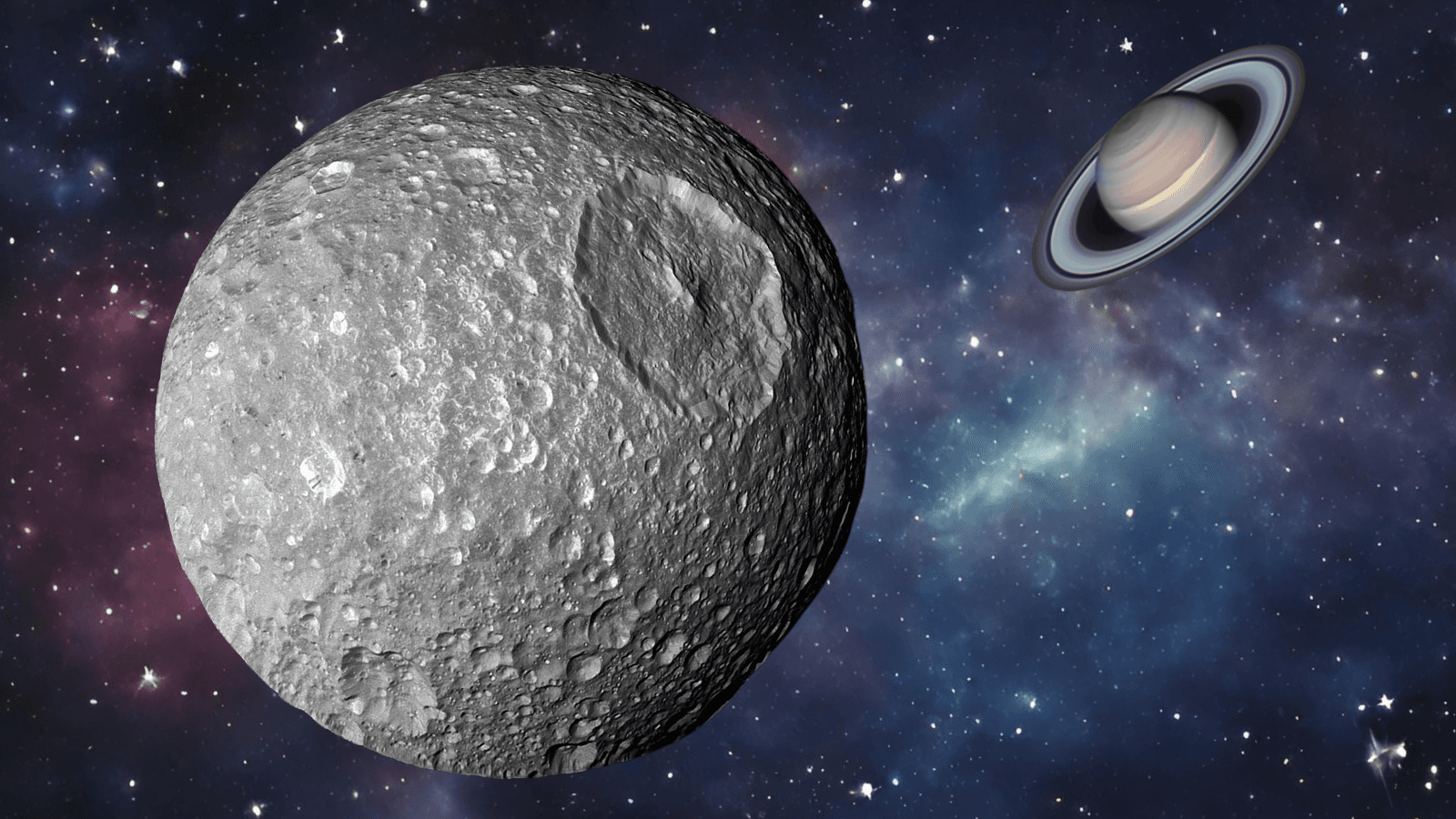
On Sept. 17, 1789, the British astronomer William Herschel discovered Saturn's "Death Star" moon,Mimas.
Of course, "Star Wars" wasn't a thing at the time, and no one had ever heard of something called a "Death Star." But there's no denying that this moon looks just like it.
Anyway, Herschel was a guy who liked to build telescopes and discover things, like the planet Uranus, tiny moons around Jupiter and Saturn, and other stuff out there in space. Shortly after he invented a huge new kind of reflecting telescope called the Herschelian telescope, he spotted Mimas orbiting Saturn.
Mimas is super tinywith a diameter of about 245 miles (394 kilometers). It is the smallest known spherical body in space that is held together by self-gravitation. It is also the smallest and innermost of Saturn's major moons.
Why it mattered
Mimas may be the Death Star moon for sci-lovers today, but in 1789, whenWilliam Herscheldiscovered the Saturnian satellite, it appeared as little more than bright dot orbitingSaturnthrough Herschel's 40-foot reflector telescope.
In fact, Mimas stayed merely a bright dot near Saturn until 1980, when NASA'sVoyager 1andVoyager 2 spacecraftflew by the ringed planet on their Grand Tour of the outer solar system. The Voyager photos of Mimas revealed the first detailed images of the crater-covered moon, but it was NASA'sCassini spacecraft, which orbited Saturn from 2004 to 2017, that truly gave the moon its place.
Those spacecraft revealed amazing views of Mimas, including the truly massive crater that gives the moon its Death Star look. The crater, named Herschel crater in honor of its discoverer, spans a full one-third of the moon's surface. It is 80 miles (130 km) across and has a cental peak that rises 3.5 miles (6 km) above its floor.
"The impact that blasted this crater out of Mimas probably came close to breaking the moon apart,"NASA has said. "Shock waves from the Herschel impact may have caused the fractures, also called chasmata, on the opposite side of Mimas."
According to NASA, Mimas appears to made almost entirely of water ice, yet is mostly frozen solid, possibly due to its elongated orbit. The moon orbits Saturn once every 22 hours at an average distance of about 115,000 miles (186,000 km), and is tidally locked (the same side faces Saturn as it moves like Earth's own moon).
The name Mimas was suggested for the moon by John Herschel, son of William Herschel. In mythology, Mimas was a giant who killed Mars during the war between the Titans and gods of Olympus. The younger Herschel named the first sevenSaturn moonsto be discovered after similar mythological characters.
NASA unveils its first space shuttle: Enterprise
Mimas may have the Star Wars angle on today's space history, but the rival sci-fi franchseStar Trekalso warped onto the stage 50 years ago today when NASA unveiled its firstspace shuttle Enterprise.
On Sept. 17, 1976, just 10 years afterStar Trek's TV debut 60 years ago, NASA officially named its first space shuttle after the TV series' iconic starship Enterprise after a write-in campaign by Trek fans urged NASA to honor the fictional starship. (NASA originally planned to name its first shuttle the Constitution.)
The entire cast of the original Star Trek TV show, as well its creator Gene Roddenberry, were on hand for Enterprise's rollout at the Rockwell manufacturing facility in Palmdale, California. The TV show's theme welcomed the shuttle out of its hangar in front of Trek icons and 600 guests.
The space shuttleEnterprise never flew in space. NASA actually used it for glide and landing tests to prove that a space plane could land like a glider after launching like a rocket.
Today,you can see the space shuttle Enterpriseat the Intrepid Sea, Air & Space Museum in New York City.
Want more space history? Check out ourfull On This Day In Space Story archiveand watch ourOn This Day In Space videos on YouTube.
Get the Space.com Newsletter
Breaking space news, the latest updates on rocket launches, skywatching events and more!
Editor-in-Chief
Tariq is the award-winning Editor-in-Chief ofSpace.comand joined the team in 2001. He covers human spaceflight, as well as skywatching and entertainment. He became Space.com's Editor-in-Chief in 2019. Before joining Space.com, Tariq was a staff reporter for The Los Angeles Times covering education and city beats in La Habra, Fullerton and Huntington Beach. He's a recipient of the2022 Harry Kolcum Awardfor excellence in space reporting and the2025 Space Pioneer Awardfrom the National Space Society. He is an Eagle Scout and Space Camp alum with journalism degrees from the USC and NYU. You can find Tariq at Space.com and as the co-host to theThis Week In Space podcaston theTWiT network. To see his latest project, you can follow Tariq on Twitter@tariqjmalik.
You must confirm your public display name before commenting
Please logout and then login again, you will then be prompted to enter your display name.