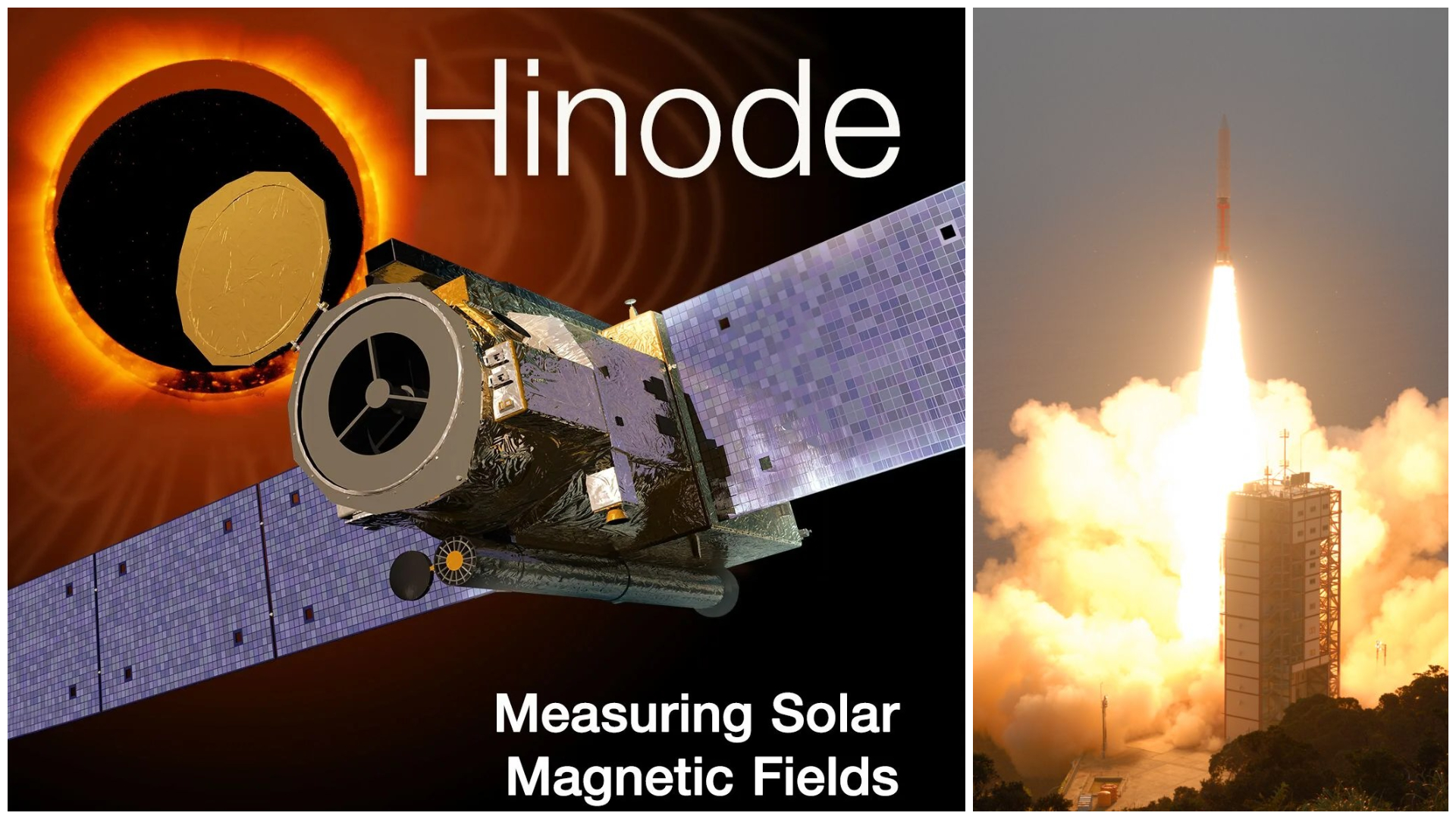
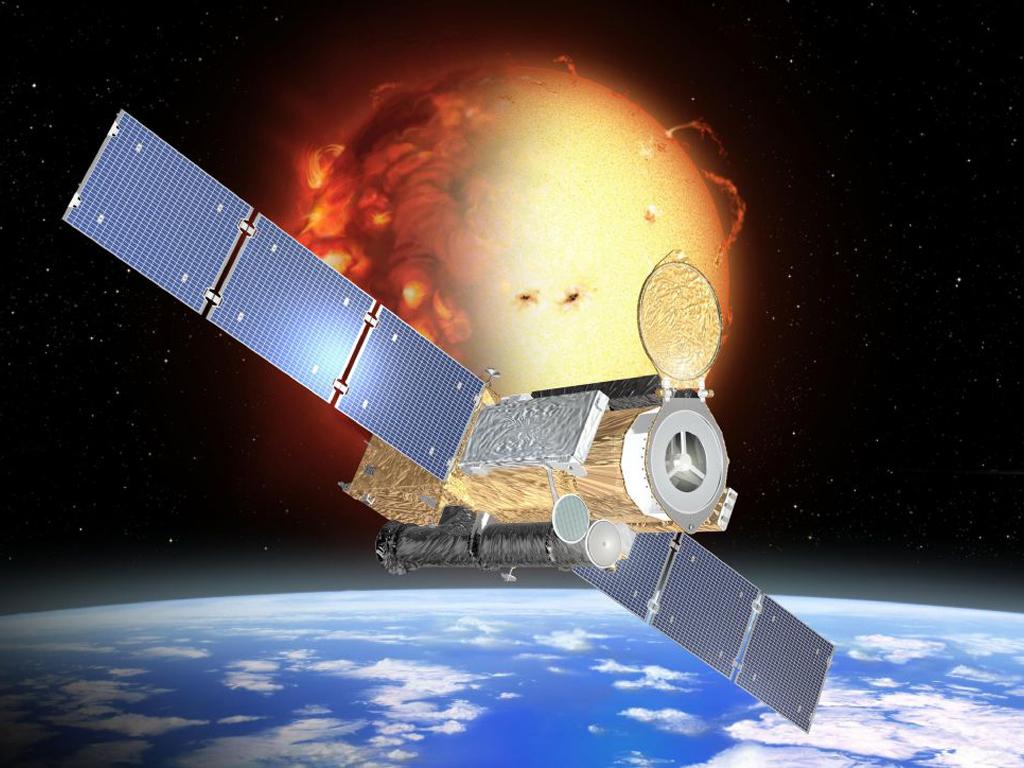
On Sept. 22, 2006, theJapanese Aerospace Exploration Agencylaunched a sun-observing satellite called Hinode, or Solar-B. It was named after the Japanese word for "sunrise."
The satellite orbits about 400 miles (640 kilometers) above the Earth in a sun-synchronous orbit, which means it's always facingthe sun.
Since Hinode launched,it's been measuring thesun's magnetic fieldsand taking cool photos ofsolar flares,sunspotsand transits across the sun.
Why it mattered
Japan's Hinode solar observatory, while led by JAXA, is a collaboration by Japan, the United States, the United Kingdom and Europe that has studied the sun for 20 years. Its Solar Optical Telescope is the first ever dedicated to measuring the strength and direction of the sun's magnetic field atthe photosphere, the surface of the sun, NASA has said.
Hinode also carried two other instruments, an EUV imaging spectromenter and X-ray telescope, to "understand the causes of eruptions in the solar atmosphere and relate those eruptions to the intense heating ofthe coronaand the mechanisms that drive the constant outflow of solar material and radiation, the solar wind," NASA addedin an overview.
One strange coincidence of Hinode's orbit, which circles the Earth once every 98 minutes, is its so-called "eclipse season." During the summer months in the Northern Hemisphere,Hinode sees a solar eclipse on every orbit, with the Earth eclipsing the sun for up to 10 minutes at a time. Because Hinode always faces the sun, its orbit allows for continous solar observations for nine months at a time.
JAXA launched Hinode on an M-V rocket from the Uchinoura Space Center in Kagoshima, Japan. Due to differences in timezones, it was Sept. 23 local time in Japan at the time of the launch (though still Sept. 22 EDT).
Hinode's cameras have capturedspectacular video and imagery of the sun's surfaceduring its mission. The mission was originally extended through 2020, with mission scientists hoping Hinode would last until 2022. But it's still going strong even after that milestone.
Want more space history? Check out ourfull On This Day In Space Story archiveand watch ourOn This Day In Space videos on YouTube.
On this day in space! Sept. 21, 2003: NASA's Galileo spacecraft crashes into Jupiter
Contributing expert
Hanneke Weitering is a multimedia journalist in the Pacific Northwest reporting on the future of aviation at FutureFlight.aero and Aviation International News and was previously the Editor for Spaceflight and Astronomy news here at Space.com. As an editor with over 10 years of experience in science journalism she has previously written for Scholastic Classroom Magazines, MedPage Today and The Joint Institute for Computational Sciences at Oak Ridge National Laboratory. After studying physics at the University of Tennessee in her hometown of Knoxville, she earned her graduate degree in Science, Health and Environmental Reporting (SHERP) from New York University. Hanneke joined the Space.com team in 2016 as a staff writer and producer, covering topics including spaceflight and astronomy. She currently lives in Seattle, home of the Space Needle, with her cat and two snakes. In her spare time, Hanneke enjoys exploring the Rocky Mountains, basking in nature and looking for dark skies to gaze at the cosmos.
With contributions from
- Tariq MalikEditor-in-Chief
You must confirm your public display name before commenting
Please logout and then login again, you will then be prompted to enter your display name.