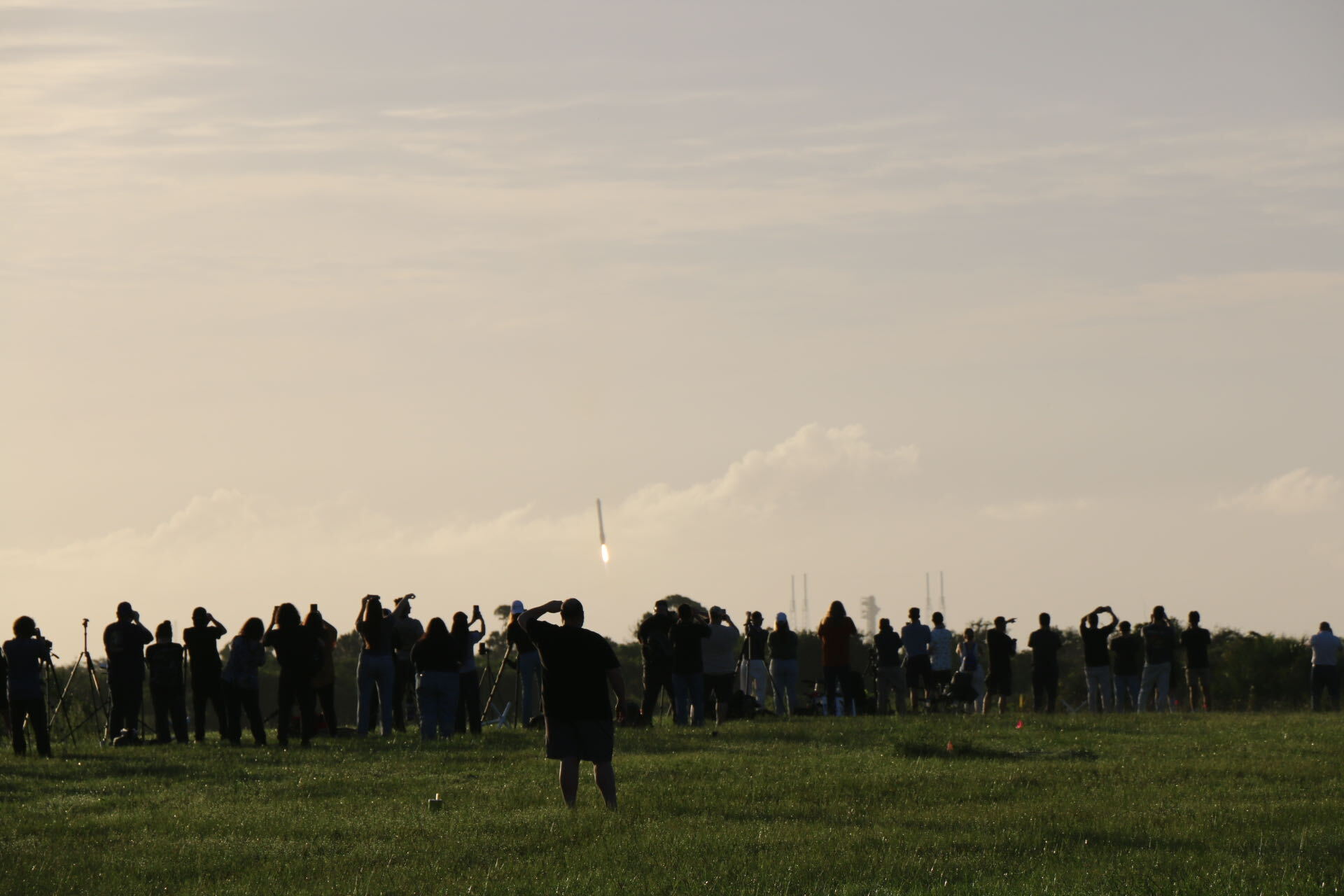
On Aug. 30, the Nancy Grace Roman Space Telescope launched into space aboard a SpaceX Falcon Heavy rocket — then, after completing their job, the rocket's boosters safely landed back on Earth. Watching the events unfold, Space.com's Chelsea Gohd caught one of these beautiful landings on camera as onlookers at NASA's Kennedy Space Center watched in awe.
What is it?
TheRoman Space Telescopeis NASA's next great observatory, meant to revolutionize how we view the cosmos. Equipped withinstrumentslike a coronagraph that can directly image exoplanets and a Wide-Field Instrument (WFI) that has a massively wide field of view, it's designed to work with big names like theHubble Space TelescopeandJames Webb Space Telescopeand reveal our universe's intricacies on a grand scale.
But to get to space, like any other space telescope, it needed a rocket to ferry it there. In this case, that was SpaceX'sFalcon Heavyrocket. Falcon Heavy is about 230 feet (70 meters) tall and can lift nearly 141,000 pounds (64 metric tons) of payload to low Earth orbit. And importantly, Falcon Heavy's two boosters are reusable.
Latest Videos From
Space
View moreWatch full video here:
After launching a payload to space, the boosters split and each lands back onEarthin an upright position. In the image above, Gohd captured one of those boosters landing in the distance.
Why is it incredible?
Though we hear about itso often, there is something undeniably dreamlike about living in a time when a rocket can land its parts back on Earth so precisely. I was also there for the launch of the Roman Space Telescope in Florida, and it was breathtaking to watch such a huge piece of equipment navigate mid-air and straighten itself before landing. The crowd in the picture was equally astonished while the event unfolded.
My mother texted me just after she watched the Roman Space Telescope launch live online, exclaiming that the booster's landing looked just like a taxi returning to its station, getting ready for the next task. I hadn't thought about it that way before, but she was correct.
One of the boosters that participated in Roman's launch landed at Landing Zone 2 and the other hit the ground at Landing Zone 40. As NASA explained in a statement, one of these boosters carried out its very first mission while the other was on itsthird.
Now, the next spectacle to take our breath away will be Roman's very first images of the universe. Those are expected to drop next year.
You must confirm your public display name before commenting
Please logout and then login again, you will then be prompted to enter your display name.
Astronomy Channel Editor
Monisha Ravisetti is Space.com's Astronomy Editor. She covers black holes, star explosions, gravitational waves, exoplanet discoveries and other enigmas hidden across the fabric of space and time. Previously, she was a science writer at CNET, and before that, reported for The Academic Times. Prior to becoming a writer, she was an immunology researcher at Weill Cornell Medical Center in New York. She graduated from New York University in 2018 with a B.A. in philosophy, physics and chemistry. She spends too much time playing online chess. Her favorite planet is Earth.