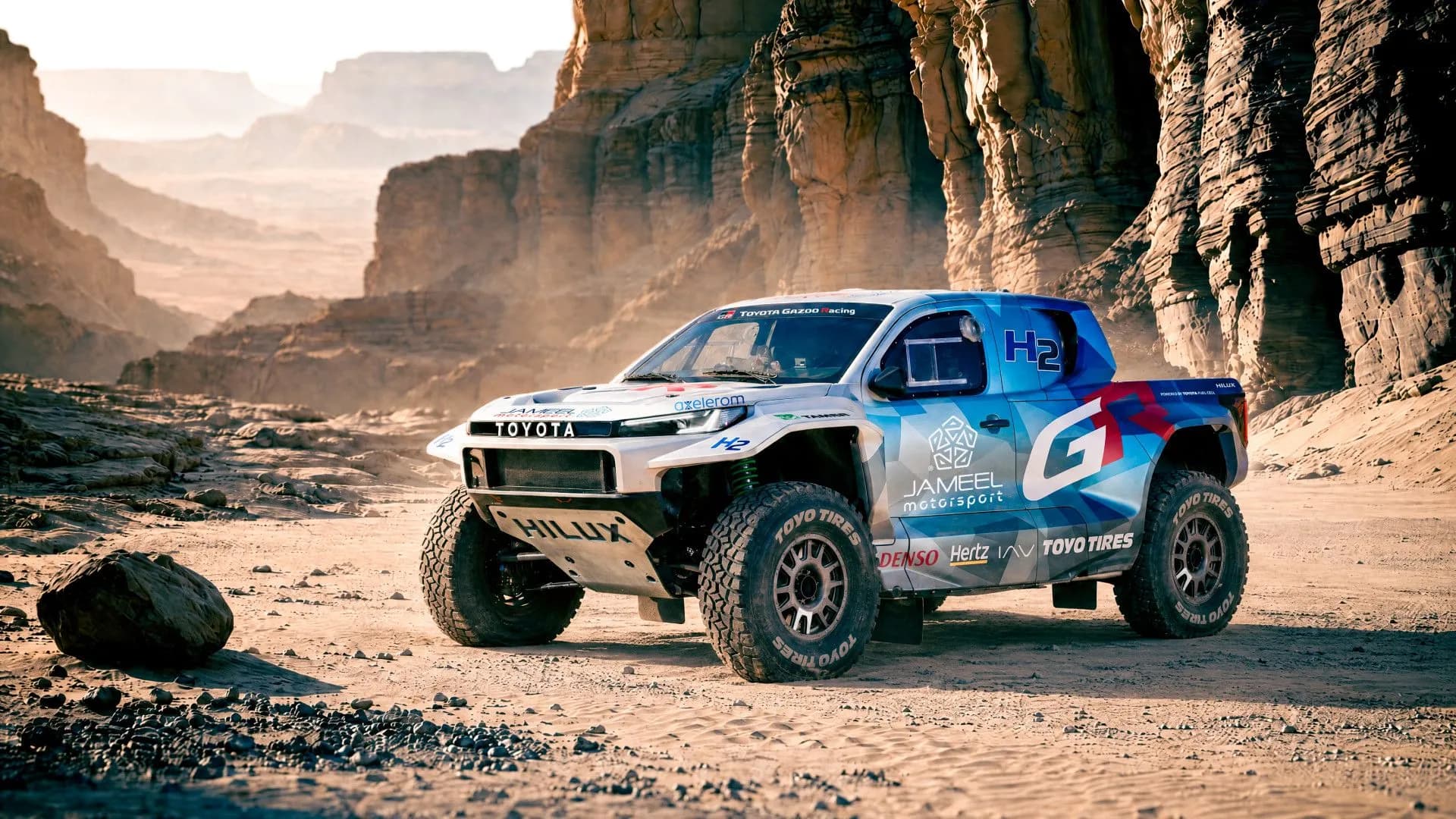
Toyota Gazoo Racing has revealed the first images of its hydrogen fuel cell-powered DKR GR FC Hilux prototype as it prepares for the 2027 Dakar Rally in Saudi Arabia.
The team shared the truck’s new details this week, positioning the experimental racer as a testbed forfuel cell technologythat could eventually reach production vehicles.
The DKR GR FC Hilux isbasedon the GR DKR Hilux EVO T1+, Toyota’s current Dakar race truck. The production-derived rally machine uses a twin-turbocharged V6, while the new prototype replaces that powertrain with ahydrogenfuel cell electric system.
Toyota has given the FC version a distinctive white-and-blue livery to separate it from the conventional racer.
Shorter than a road Hilux
The prototype keeps the custom bodywork and chassis developed for the rally program. Its wheelbase is considerably shorter than that of a roadgoing Hilux, helping the truck handle tight and uneven sections of desert terrain. High-clearance fenders surround its oversized tires, while long-travel suspension is designed to absorb severe impacts and large terrain changes.
Fuel cell output remains secret
Toyota has yet to reveal the electric motor output or the distance the prototype can travel between hydrogen refueling stops. For comparison, FIA regulations limit the twin-turbo V6 version to 400 hp and 487 lb-ft of torque. The fuel cell system generates electricity for the truck's electric drive system, with water as the direct emission from the fuel cell operation.
A test across 621 miles
The DKR GR FC Hilux will enter Dakar Future Mission 1000, a category created for experimental vehicles. Toyota plans to put the prototype through more than 1,000 km, or 621 miles, of demanding terrain during 13 stages. The competition environment is intended to expose the fuel cell system to the heat, vibration and impacts expected during long-distance desert racing.
Cooling is a major target
Toyota says its development work will focus on downsizing the fuel cell system, improving cooling and increasing durability. Those areas are particularly important for a vehicle operating for hours in extreme desert conditions. The Dakar program gives engineers a way to gather data under loads that would be difficult to reproduce during conventional road testing.
Road-going hydrogen Hilux planned
Toyota has already confirmed plans for a production Hilux FCEV in 2028. The road-legal hydrogen pickup is targeting a range of 248 miles, or 400 km, and a towing capacity of 5,512 lb, or 2,500 kg. It will join the Hilux lineup alongside fully electric and mild-hybrid diesel versions.
Toyota keeps its Dakar contender
The hydrogen prototype will race alongside Gazoo Racing's main Dakar entry, the GR DKR Hilux EVO T1+. Toyota has recorded four overall Dakar victories with its Hilux program, winning in 2019, 2022, 2023 and 2025. The team's conventional truck therefore remains central to Toyota's competitive desert program as the FC prototype begins its development campaign.
2026 result adds another challenge
Toyota's most recent Dakar campaign in 2026 ended without another overall victory. Dacia's Sandrider took the top position after mechanical problems forced the leading Toyota out of contention. The result adds context to the manufacturer's continuing development of its rally vehicles as it prepares both its established Hilux racer and hydrogen technology for future Dakar competition.