Introduction
Back when Ars first started, Intel had just released the first Celeron processor aimed at the low end market, and since it lacked an off-die backside cache like its cousin the PII it turned out to beextremelyoverclockable. The Celeron really pushed the overclocking craze into the mainstream in a big way, and Ars got its start by providing seats on the bandwagon to anyone with a web browser and a desire to learn the hows and whys of Celeron overclocking.Frank Monroe’s Celeron Overclocking FAQwas one of the most relentlessly popular articles on Ars for what seemed like forever, and “Celeron” and “overclocking” were the two main search terms that brought people in from Yahoo, which at the time was our number one referrer. (In fact, some time ago my girlfriend mentioned that she had actually come across Ars via Yahoo and read the OC FAQ years before she and I ever even met.)
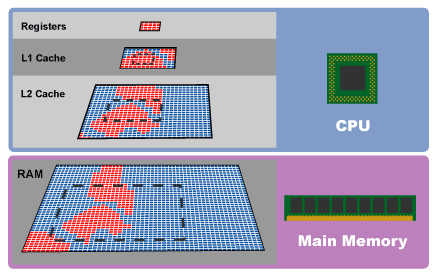
Along with its overclockability, there was one peculiar feature of the “cacheless wonder,” as the Celeron was then called, that blew everyone’s mind: it performed almost as well on Quake benchmarks as the cache-endowed PII. What became evident in the ensuing round of newsgroup and BBS speculation over this phenomenon was that few people actually understoodhowcaching works to improve performance. My suspicion is that this situation hasn’t changed a whole lot since the Celeron’s heyday. However, what has changed since then is the relative importance of caching in system design. Despite the introduction of RAMBUS, DDR, and othernext-gen memory technologies, CPU clockspeed and performance have grown significantly faster than main memory performance. As a result L1, L2, and even L3 caches have become a major factor in preventing relatively slow RAM from holding back overall system performance by failing to feed code and data to the CPU at a high enough rate.