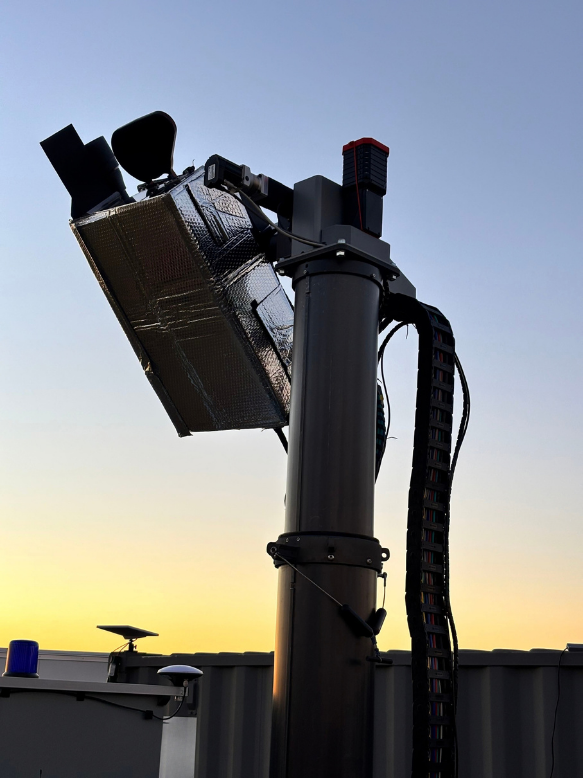
US-based PowerLight Technologies has received an expanded investment from the Department of War to advance a field-deployable Aerial ReCharge (ARC) system.
The follow-on award comes from the Department of War’s Operational Energy – Innovation (OE-I) Directorate. It builds on the ARC development under the PTROL-UAS program and the April 2026 demonstration at the Shaw Air Force Base.
Drones are being increasingly used in modern warfare for short and long-range missions, including strikes, Intelligence, Surveillance, and Reconnaissance (ISR) missions, and more. Their usage in other areas, such as monitoring oil pipelines and law and order, is also on the rise.
One significant hurdle to drones being used more often is power. Battery-powered drones have to return to base after they run out of energy; this leads to a situation when there is either downtime for missions or multiple drones need to be utilized to fill the gaps.
Increasing the mission time for military drones
The battery life of unmanned aircraft systems (UAS) is measured in hours. Every time a military drone returns to base, the recovery cycle includes an operator breaking cover, swapping its batteries, and then relaunching it in a risky environment.
The ARC system can therefore prove to be very useful in a contested environment for personnel on the ground. It uses laser power beaming to recharge the drones or their payloads in flight, which can drastically eliminate the problem.
Whenever the drone’s batteryneeds a recharge, after reaching a set minimum point, the UAS can initiate a handshake with the ARC transmitter and recharge itself while still in flight. The drone can then return to carrying on its mission without having to make a landing.
More from Military
See AllMilitaryUS firm unveils 864-mile-range Troublemaker drone for one-way attack missionsMilitaryUS Army upgrades digital logistics tools after supply-chain challenges in Iran warMilitaryUS’ 100,000-ton aircraft carrier returns from Iran with hundreds of war kill markingsMilitaryUS Army modernizes aging rail fleet with new locomotives and track equipmentMilitaryDriverless resupply vehicle pairs 500-mile range with drone-killing shotgun“Power beaming means more time on mission and less time on the ground,” OE-I Combat Power Portfolio Lead Chris DePuma said.
He went on to add that by enabling autonomous, in-flight recharging, the Aerial ReCharge system reduces the need to land and swap batteries, extending mission endurance and reducing risk in contested environments.
How does the ARC system work?
The ARC system uses optical power beaming, whichconverts electricityinto a precisely shaped beam of laser light that is transmitted through air, space, fiber, or water and converted back into electricity at the receiver.
PowerLight says that the beam travels at the speed of light, carries no radio frequency signature, and can be sent over long distances.
For demonstration, the ARC receiver was integrated into the Kraus Hamdani Aerospace K1000ULE, an ultra-long endurance drone. The U.S. Air Forces Central (AFCENT) had cleared the drone platform for use, and the ARC system is being matured on an aircraft the operators already fly.
PowerLight’s engineering and test team is embedded at Shaw AFB, developing CONOPS and collecting data with AFCENT mission planners and operators during field testing to support transition to theater.
“Power beaming applies well beyond a single domain, from ground-to-ground, ground-to-air, air-to-air, and space-to-space, and that is the opportunity ahead,”said Tim Jenks, CEO, PowerLight.
Get the latest in engineering, tech, space & science - delivered daily to your inbox.
By subscribing, you agree to our
Terms of Useand
PoliciesYou may unsubscribe at any time.
0
COMMENT
Subscribe to
Today!
Access to exclusive content, expert insights and a deeper dive into engineering and tech. No ads, no limits.
Explore Now!By
Abhishek BhardwajAbhishek brings a wealth of experience in covering diverse stories across different beats. Having contributed to renowned wire agencies and Indian media outlets like ANI and NDTV, he is keenly interested in Tech, Business and Defense coverage.
- 1Inside BYD's new luxury car powered by solid-state EV batteries
- 2Autonomous combat drone capabilities to get massive expansion with $16 million funding boost
- 3Ship-to-shore connector that can enable access to 80% of world’s coastline to be delivered to US Navy
- 4US Marines validate AH-1Z precision weapon delivery to streamline fleet training
- 5Watch: Two-armed robot throws, catches, and hits balls like a baseball champ
US-based PowerLight Technologies has received an expanded investment from the Department of War to advance a field-deployable Aerial ReCharge (ARC) system.
The follow-on award comes from the Department of War’s Operational Energy – Innovation (OE-I) Directorate. It builds on the ARC development under the PTROL-UAS program and the April 2026 demonstration at the Shaw Air Force Base.
Drones are being increasingly used in modern warfare for short and long-range missions, including strikes, Intelligence, Surveillance, and Reconnaissance (ISR) missions, and more. Their usage in other areas, such as monitoring oil pipelines and law and order, is also on the rise.
One significant hurdle to drones being used more often is power. Battery-powered drones have to return to base after they run out of energy; this leads to a situation when there is either downtime for missions or multiple drones need to be utilized to fill the gaps.
Increasing the mission time for military drones
The battery life of unmanned aircraft systems (UAS) is measured in hours. Every time a military drone returns to base, the recovery cycle includes an operator breaking cover, swapping its batteries, and then relaunching it in a risky environment.
The ARC system can therefore prove to be very useful in a contested environment for personnel on the ground. It uses laser power beaming to recharge the drones or their payloads in flight, which can drastically eliminate the problem.
Whenever the drone’s batteryneeds a recharge, after reaching a set minimum point, the UAS can initiate a handshake with the ARC transmitter and recharge itself while still in flight. The drone can then return to carrying on its mission without having to make a landing.
More from Military
See AllMilitaryUS firm unveils 864-mile-range Troublemaker drone for one-way attack missionsMilitaryUS Army upgrades digital logistics tools after supply-chain challenges in Iran warMilitaryUS’ 100,000-ton aircraft carrier returns from Iran with hundreds of war kill markingsMilitaryUS Army modernizes aging rail fleet with new locomotives and track equipmentMilitaryDriverless resupply vehicle pairs 500-mile range with drone-killing shotgun“Power beaming means more time on mission and less time on the ground,” OE-I Combat Power Portfolio Lead Chris DePuma said.
He went on to add that by enabling autonomous, in-flight recharging, the Aerial ReCharge system reduces the need to land and swap batteries, extending mission endurance and reducing risk in contested environments.
How does the ARC system work?
The ARC system uses optical power beaming, whichconverts electricityinto a precisely shaped beam of laser light that is transmitted through air, space, fiber, or water and converted back into electricity at the receiver.
PowerLight says that the beam travels at the speed of light, carries no radio frequency signature, and can be sent over long distances.
For demonstration, the ARC receiver was integrated into the Kraus Hamdani Aerospace K1000ULE, an ultra-long endurance drone. The U.S. Air Forces Central (AFCENT) had cleared the drone platform for use, and the ARC system is being matured on an aircraft the operators already fly.
PowerLight’s engineering and test team is embedded at Shaw AFB, developing CONOPS and collecting data with AFCENT mission planners and operators during field testing to support transition to theater.
“Power beaming applies well beyond a single domain, from ground-to-ground, ground-to-air, air-to-air, and space-to-space, and that is the opportunity ahead,”said Tim Jenks, CEO, PowerLight.
Get the latest in engineering, tech, space & science - delivered daily to your inbox.
By subscribing, you agree to our
Terms of Useand
PoliciesYou may unsubscribe at any time.
0
COMMENT
Subscribe to
Today!
Access to exclusive content, expert insights and a deeper dive into engineering and tech. No ads, no limits.
Explore Now!By
Abhishek BhardwajAbhishek brings a wealth of experience in covering diverse stories across different beats. Having contributed to renowned wire agencies and Indian media outlets like ANI and NDTV, he is keenly interested in Tech, Business and Defense coverage.
- 1Inside BYD's new luxury car powered by solid-state EV batteries
- 2Autonomous combat drone capabilities to get massive expansion with $16 million funding boost
- 3Ship-to-shore connector that can enable access to 80% of world’s coastline to be delivered to US Navy
- 4US Marines validate AH-1Z precision weapon delivery to streamline fleet training
- 5Watch: Two-armed robot throws, catches, and hits balls like a baseball champ