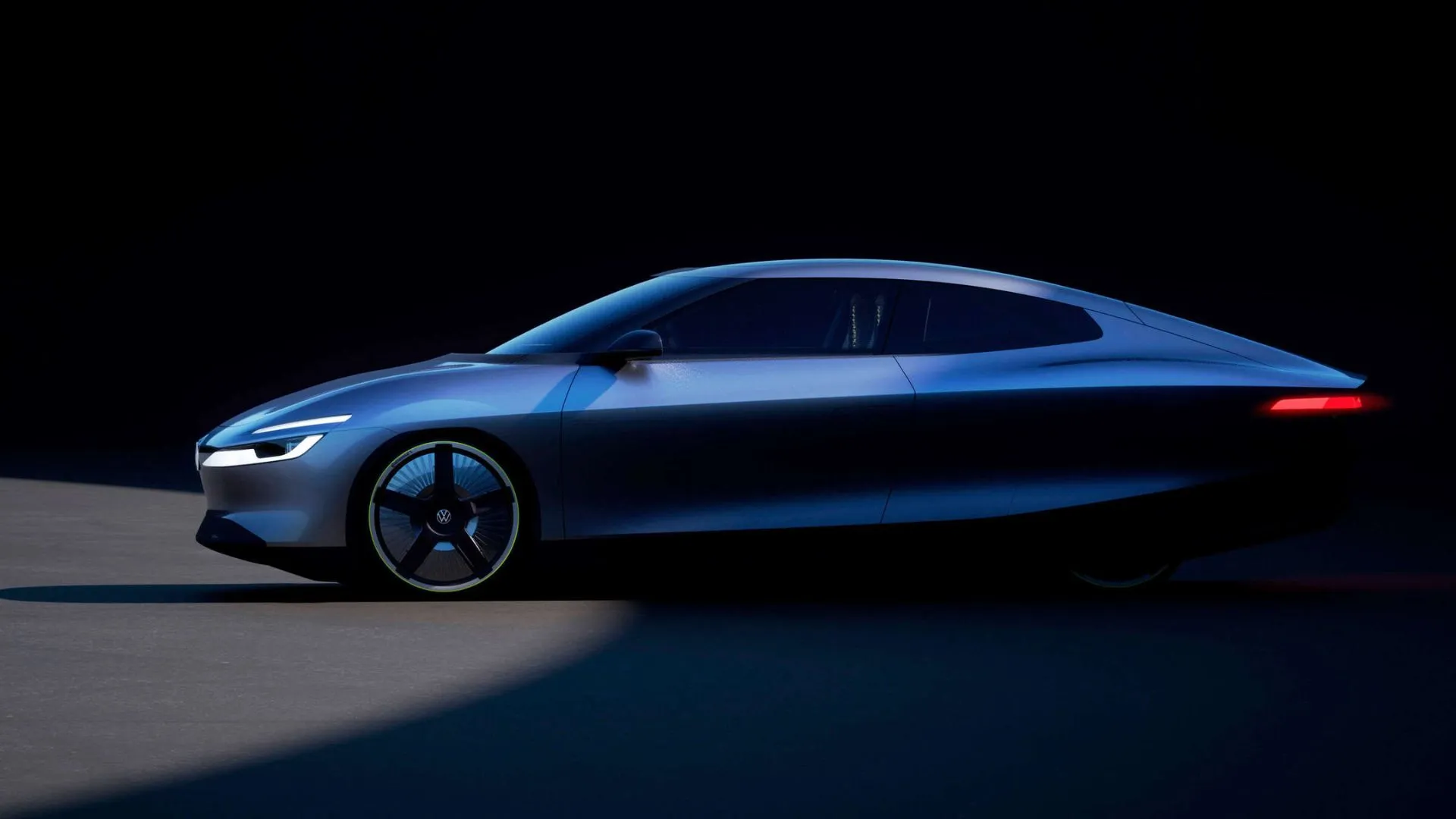
Volkswagen has unveiled its Mission Efficiency electric concept, a research car built to show how much energy consumption can be reduced through extreme aerodynamic design.
Revealed on September 14, the experimental EV has already posted record-setting drag and efficiency results. Volkswagen says it is the most efficient road-registered car ever measured, with its technology aimed at future smallEVssuch as the ID. Polo.
The Mission Efficiency has achieved a drag coefficient of just 0.158, giving it the lowest figure claimed for a road-approvedcar. For comparison, the production Lucid Air has a drag coefficient of 0.197. Volkswagen says the concept reached 9.59 miles per kWh under ideal conditions: constant speed, no gradients, and climate control off.
Theconceptalso completed a 794-mile journey from Volkswagen’s development center in Wolfsburg, Germany, to Vienna, Austria. It averaged 42 mph and reached a maximum speed of 86 mph. The car needed only one charging stop and arrived with more than 100 miles of range remaining. Including charging losses, Volkswagen recorded 8.27 miles per kWh during the trip.
A successor to the XL1
The Mission Efficiency follows Volkswagen's earlier experiments with ultra-efficient vehicles, particularly the XL1. Its long, low profile has a similar teardrop shape, although the new concept is almost 15.7 feet long. Its body combines carbon-fiber-reinforced plastic with aluminum, while fully enclosed rear wheels help control airflow around the vehicle.
Airflow shapes the exterior
Volkswagen redesigned the underside and body surfaces to reduce turbulence and aerodynamic resistance. Three active cooling flaps sit at the front and automatically adjust their openings based on cooling needs. This lets the car limit airflow through the front when cooling demand is low, further reducing drag during driving.
Solar power adds range
Solar panels are integrated into the roof and rear window. Volkswagen says they generate electricity for auxiliary systems, reducing the load on the high-voltage battery. Under suitable conditions, the solar setup can contribute about 18 miles of additional range, adding another efficiency measure without requiring a larger battery.
Production technology underneath
The concept uses a 133-horsepower electric motor mounted at the front and is based on the MEB+ architecture used for Volkswagen's upcoming EVs. Its battery provides 54.9 kWh of usable capacity, compared with 52 kWh in the ID. Polo. The concept also uses a narrower rear track and modified suspension positioning to improve airflow.
Lightweight cabin design
Inside, Volkswagen has focused on reducing weight and keeping the cabin simple. Woven fabric covers parts of the seats, dashboard, and doors. The Mission Efficiency has four seats in a 2+2 layout, though the rear seats are mainly for smaller passengers. A 487-liter trunk provides useful cargo space, with extra storage available above the rear wheels.
A minimalist approach to technology
The cabin does away with a conventional infotainment system. Drivers can mount a smartphone or tablet instead, while the concept has no built-in speaker system. Volkswagen used a portable Bluetooth speaker during the Vienna efficiency run. The approach could offer ideas for cheaper future EVs, including the planned ID.1.
A rolling laboratory for future EVs
Volkswagen has not announced plans for series production, although it says production can never be completely ruled out. The Mission Efficiency is primarily a technology demonstrator that explores how aerodynamics, weight reduction, and careful energy management can improve EV range. Its results could influence future Volkswagen models without relying on substantially larger batteries.