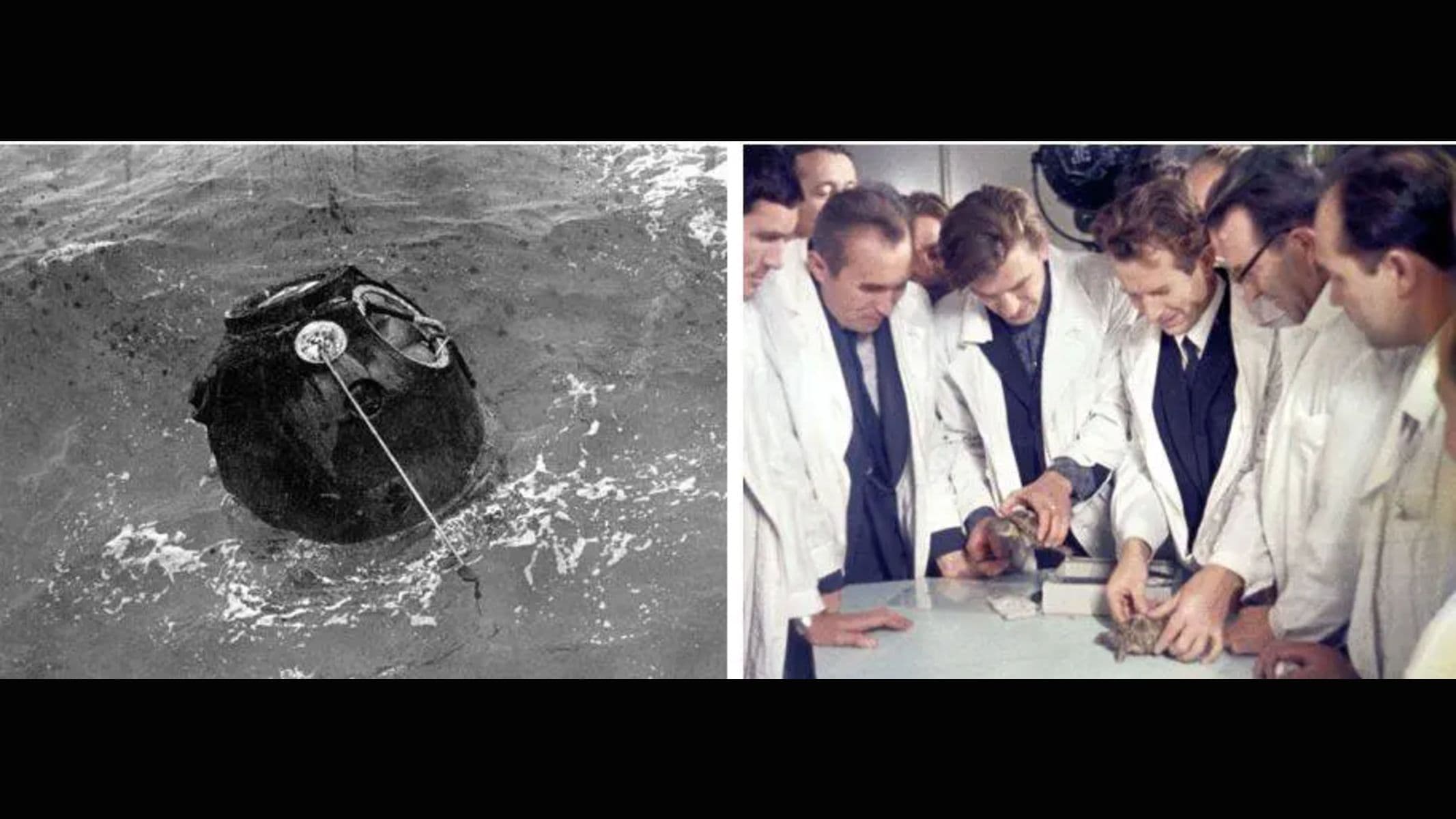
On Sept. 15, 1968, the Soviet Union launched the Zond 5 spacecraft on a mission to loop aroundthe moonand return to Earth. There were no cosmonauts aboard, but there were several smaller vertebrates — including the first two tortoises to ever go to space!
Other passengers included wine flies, mealworms, plants and seeds. These were the first animals in deep space and the first to travel around the moon.
After looping around the moon, the Zond 5 spacecraft turned around and came back to Earth. It was supposed to land in Kazakhstan on Sept. 22, but the spacecraft's guidance system failed, and it splashed down in the Indian Ocean instead.
The Soviets did recover the capsule and found that the tortoises and other critters were still alive, although they had lost some weight since the start of the mission.
Why it mattered
In September of 1968, theSpace Raceto the moon was in full swing. NASA was just three months away from the historicApollo 8mission, which sent the first astronauts around the moon in daring first-of-its-kind mission.
But with Zond 5, the Soviet Union scored an early win for the first circumlunar flight that launched from the Earth to the moon, then returned for a landing (or splashdown, in this case). In fact, the flight may have spurred NASA to launch Apollo 8.
"The flight of Zond 5 caused concern in the U.S. that the Soviets would place cosmonauts aboard the next Zond and complete the first crewed circumlunar mission. At about this time, a U.S. Corona reconnaissance satellite photographed an N-1 rocket on its pad at Baikonur,"NASA wrote in a report, adding that NASA's then-chief James Webb likely saw those intelligence reports.
"The apparently successful Zond 5 mission coupled with the photos of the Soviet lunar booster on the launch pad may have contributed to the decision to send Apollo 8 on its circumlunar mission in December 1968, bringing the moon landing one step closer."
Zond 5 launched fromBaikonur Cosmodromeatop aProton rocketand took three days to reach the moon. The two tortoises on board were, appropriately, Russian steppes tortoises, NASA has said. After looping around the moon, the critters spent a few more days in transit for the trip home.
It was a guidance system error that led the Zond 5 capsule to splash down in the Indian Ocean instead of landing on land as planned. But the landing on Sept. 21 wasn't the end of the road for the Zond 5 tortoises and other animals.
The Soviet recovery ship Vasily Golovnin plucked the Zond 5 capsule from the ocean and returned to port in what is now Mumbai, India on Oct. 3, weeks later! They wer ethen flown to Moscow on an Antonov-12 cargo plane before the capsule was finally opened to find the tortoises alive and in good health. You can still view the Zond 5 capsule at the RSC Energia museum in Korolev.
Cassini's Grand Finale death dive at Saturn in 2017
A bunch of space traveling tortoises and other animals aren't the only notable space event that happened today in history.
On Sept. 15, 2017, NASA'sCassini spacecraftdied in a blaze of glory as itcrashed into Saturnafter 13 years orbiting the ringed planet. NASA ended the mission in a fiery plunge becauseCassini was running out of fueland the space agency wanted to ensure it wouldn't crash into one of Saturn's icy moons, likeEnceladus, and contaminate them. They called itCassini's Grand Finale.
Launched in 1997, the $3.26 billion Cassini mission entered orbit aroundSaturnin 2004 and dropped a European Huygens probe onto the cloudy moonTitanin early 2005. The mission was expected to last until 2008, but was extended twice, ultimately stretching through to September 2017.
During its mission life, Cassini discovered a trove if newSaturn moons, found a strange hexagon at the planet's north pole and tracked mesmerizing details of the planet's many rings.
"Congratulations to you all," Earl Maize, the Cassini program manager, said to the mission teamafter the spacecraft signal was lost."This has been an incredible mission, an incredible spacecraft, and you're all an incredible team. I'm going to call this the end of mission."
Want more space history? Check out ourfull On This Day In Space Story archiveand watch ourOn This Day In Space videos on YouTube.
On this day in space! Sept. 14, 1966: NASA's Gemini 11 astronauts set altitude record for Earth orbit
You must confirm your public display name before commenting
Please logout and then login again, you will then be prompted to enter your display name.
Contributing expert
Hanneke Weitering is a multimedia journalist in the Pacific Northwest reporting on the future of aviation at FutureFlight.aero and Aviation International News and was previously the Editor for Spaceflight and Astronomy news here at Space.com. As an editor with over 10 years of experience in science journalism she has previously written for Scholastic Classroom Magazines, MedPage Today and The Joint Institute for Computational Sciences at Oak Ridge National Laboratory. After studying physics at the University of Tennessee in her hometown of Knoxville, she earned her graduate degree in Science, Health and Environmental Reporting (SHERP) from New York University. Hanneke joined the Space.com team in 2016 as a staff writer and producer, covering topics including spaceflight and astronomy. She currently lives in Seattle, home of the Space Needle, with her cat and two snakes. In her spare time, Hanneke enjoys exploring the Rocky Mountains, basking in nature and looking for dark skies to gaze at the cosmos.
With contributions from
- Tariq MalikEditor-in-Chief