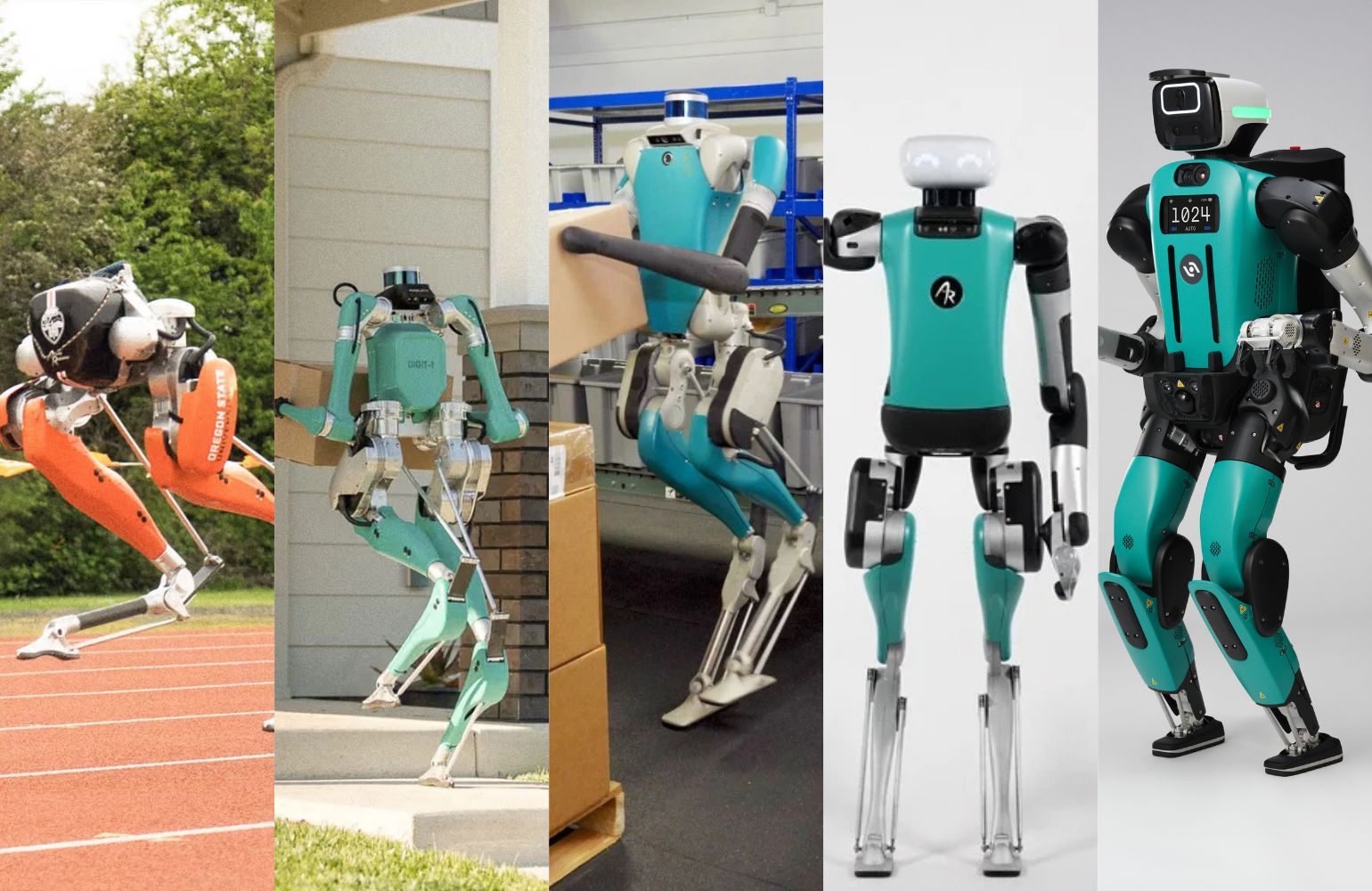
From left to right: Cassie and Digit through the years. | Source: Agility Robotics
Agility Robotics has been operating for over 10 years, and in that time it’s created five different versions of its Digit humanoid. The company has grown from its roots in the Dynamic Robotics Lab at OSU, to having three offices across the country, over 400 employees, and a factory that can build up to 10,000 robots annually.
With the release of Digit 5, we’re looking back at how Agility’s technology has evolved over the years. The latest versions of Digit, Agility’s Co-Founder and Chief Robot Officer Jonathan Hurst toldThe Robot Report, are built around the realities that come with doing actual work in partners’ facilities.
https://www.therobotreport.com/wp-content/uploads/2026/09/The-Evolution-of-Digit-3.mp4Agility’s story starts with Cassie
Before Agility built Digit, it created Cassie, a bipedal robot optimized to run fast. Hurst said Cassie represents the R&D phase of Agility. Cassie took its first steps in 2016.
Cassie features ostrich-like legs, which will become a hallmark of Agility’s robots until Digit 5. Its bird-like features reflect the company’s priorities at the time.
“The fact that we even got to a leg configuration that looks like a bird was entirely coincidental, but promising and encouraging,” Hurst said. “Ostriches can run 40 miles an hour, and keep going all day long, so we arrived at that configuration because we were trying to achieve that same goal.”
While the company didn’t continue making additional iterations of Cassie, the robot did continue to break records. In 2022, Cassieran100 meters with no falls in 24.73 seconds at OSU’s Whyte Track and Field Center. The robot established aGuinness World Recordfor the fastest 100 meters by a bipedal robot.
The early days of Digit
In 2017, Agility released the first iteration of Digit. This made the company a very early entrant to thehumanoidmarket, which now seems togrow more crowded every day. Hurst said the release of the first Digit marked the start of the company’s proof-of-concept era. The company said the first version of Digit was built for researchers.
Agility commercializes Digit by its third iteration
By the time AgilityreleasedDigit 3 in 2019, it was ready to commercialize the robot for the first time. At the time, Agility focused on using Digit to deliver packages straight to customers doors, as well as for stacking boxes in warehouses. Digit’s legs would give it an advantage over other robotic delivery options, which typically can’t bring packages all the way to the front door. Digit 3 could pick up and stack boxes weighing up to 40 lb. (18 kg).
An early version of Digit places a box on a doorstep during a delivery trial. | Credit: Agility
That same year, Agility sold its first robots to Ford, which purchased the the company’s first two robots off the production line. The automaker said it would explore how Digit could be placed in self-driving delivery vans to carry packages from vans to customers’ front doors.
Agility finds the right use case with Digit 4
Digit 4, which the companyreleasedin 2023, is the last Agility robot with its bird-like legs, and the last robot in the company’s proof-of-concept era. “We started deploying the robots and showing that it can move boxes, it can deliver packages to the front door, it can move totes, it can move bins, it can do all of this stuff,” Hurst said.
Agility built Digit 4 specifically to carry out tasks in warehouses and distribution centers. The robot also featured newly designed end effectors optimized for reaching, pulling, picking up, and placing objects commonly found in e-commerce and shipping warehouses, like plastic totes.
Digit 4 has been deployed withToyota Motor Manufacturing Canada Inc.,GXO Logistics,Schaeffler,Amazon, and more. Hurst said the company’s learnings from these deployments went into the next generation of its robot.
Digit 5 starts a new phase for Agility
With Digit 5, Agility isfocusingon the practical requirements that come with operating a robot in a logistics or manufacturing facility. Digit 5 has new legs, a longer battery life, and is able to work around people.
Digit’s new legs look much more like a person’s legs, which, again, goes back to the robot’s intended use case. Agility isn’t designing for speed anymore. Now, the company is prioritizing strength. “This is where the engineering took us,” Hurst said. “Future configurations may look different depending on the requirements.”
Digit 5 doesn’t need to work in a roped-off area away from people. This is important, because the few humanoids that are being tested in industrial facilities currently aren’t working near human workers. As people get closer to Digit 5, it evaluates the risk, slows down, and eventually stops completely. According to Agility, the robot responds dynamically to situations to decide its behavior; there are no defined zones.
Hurst said this is the first step towards creating robots that can work with humans, not just near them.
“Twenty or thirty years from now, we’ll have robots in our homes. It’ll be a natural question to look back and say, ‘What did the first humanoid robots look like?'” Hurst said. “Being the first commercially deployed humanoid robot, and being the first functionally safe humanoid robot, those are important steps on getting to the home, and getting robots to be part of everyday life.”
Agility isn’t just ramping up deployments in this new phase. The company plans to go public through a proposed SPAC merger with Churchill Capital Corp. XI. TheSPAC values Agility at $2.5 billion.
Editor’s Note:Hurst will be taking part in the keynote, “The Next 20 Years of Robotics” atRoboBusinesson October 20-21. Pras Velagapudi, Agility’s CTO, will take part in the “State of Humanoids” keynote.Buy your full conference passfor the show now.
Register now and help us celebrate 20 years of RoboBusiness!