California Still Golden Despite Job Losses: Industry Group
SAN DIEGO—California’s three life sciences clusters all lost jobs last year, yet the industry remains a major engine of innovation and economic growth, according to a report released by the state’s largest life sciences organization to coincide with the Biotechnology Industry Organization (BIO) International Convention being held here.
BIOCOM California quantified the economic impact of the Golden State’s life sciences industry as generating $394 billion in economic output in 2025—a figure that goes beyond the direct impact of the 406,505 people employed by life sciences employers across the state. The impact figure includes indirect impact (activity generated through suppliers, vendors, and subcontractors supporting the industry) and induced impact (the household spending generated by workers employed in both life-sci organizations and supporting industries).
When indirect and induced impact are accounted for, the life sciences sustain 1,079,365 jobs statewide, the report stated.
However, all three of the state’s top-tier life-sci clusters—the San Francisco Bay Area, San Diego, and the Los Angeles/Orange County region—saw decreases in employment within the industry last year, according to the report.
San Francisco ranks second in the latest edition ofGEN’s nationally-quoted A-List ofTop 10 U.S. Biopharma Clusters, unchanged from a year ago, while San Diego slid one position to sixth, and LA/Orange County slipped one notch to eighth.
“Continued biotech winter”
“California, like the other states in the country, are still showing the effects of the pandemic and the recovery from that, because it was such a large run up of investment and hiring and building of new space, followed by a pretty significant drop off in 2022, 23,” Tim Scott BIOCOM California’s president and CEO, explained in an interview withGENconducted at the organization’s booth within the convention’s exhibition floor.
“And then we have the continued biotech winter that’s been caused mostly through the instability at the federal level in terms of policy,” Scott added.
He cited NIH funding cuts, the delay in re-authorizing the Small Business Innovation Research (SBIR) and Small Business Technology Transfer (STTR) seed funding programs, tariffs, and the “most favorite nation” drug pricing framework championed by the Trump administration as a vehicle for lowering drug prices: “All of these things have led the industry and the investors in the industry to pause.”
Most of the life-sci job decline was concentrated in the Bay Area and San Diego regions, which together accounted for 88% of job losses.
The San Francisco Bay Area saw its life-sci workforce slide 2.7% from 2024 to 137,779 jobs last year, driven mainly by decreasing employment in scientific/research tools, biotechnology, and biopharmaceuticals. The San Diego region finished 2025 with 61,866 jobs, a 2.55% decline from the previous year, due primarily to the loss of jobs in the R&D in physical, engineering, and life sciences and electromedical and electrotherapeutic apparatus manufacturing sectors.
Greater Los Angeles, which BIOCOM California defines as Los Angeles, San Bernardino, and Ventura counties, saw its employment base shrink 0.5% year-over-year, to 143,153 last year, with the largest employment decrease coming in drug wholesaler positions. Orange County’s life-sci workforce also dipped by 0.5%, sliding to 57,213 jobs, driven by cuts in scientific/research tools and medical devices and equipment employment—though Orange County also saw increases in biotechnology and research and testing jobs.
“Significant driver”
“In spite of the slight decrease in growth this year, we’re still at about $400 billion in economic output for California in the life sciences. That’s the second largest industry in California,” Scott said. “It’s still a significant driver of economic activity and of innovation.”
Another driver of innovation, NIH funding, stayed flat last year compared to 2024 at $5.23 billion for all of California. But the number of NIH awards statewide fell 8.5% from 9,384 in 2024 to 8,587 in 2025.
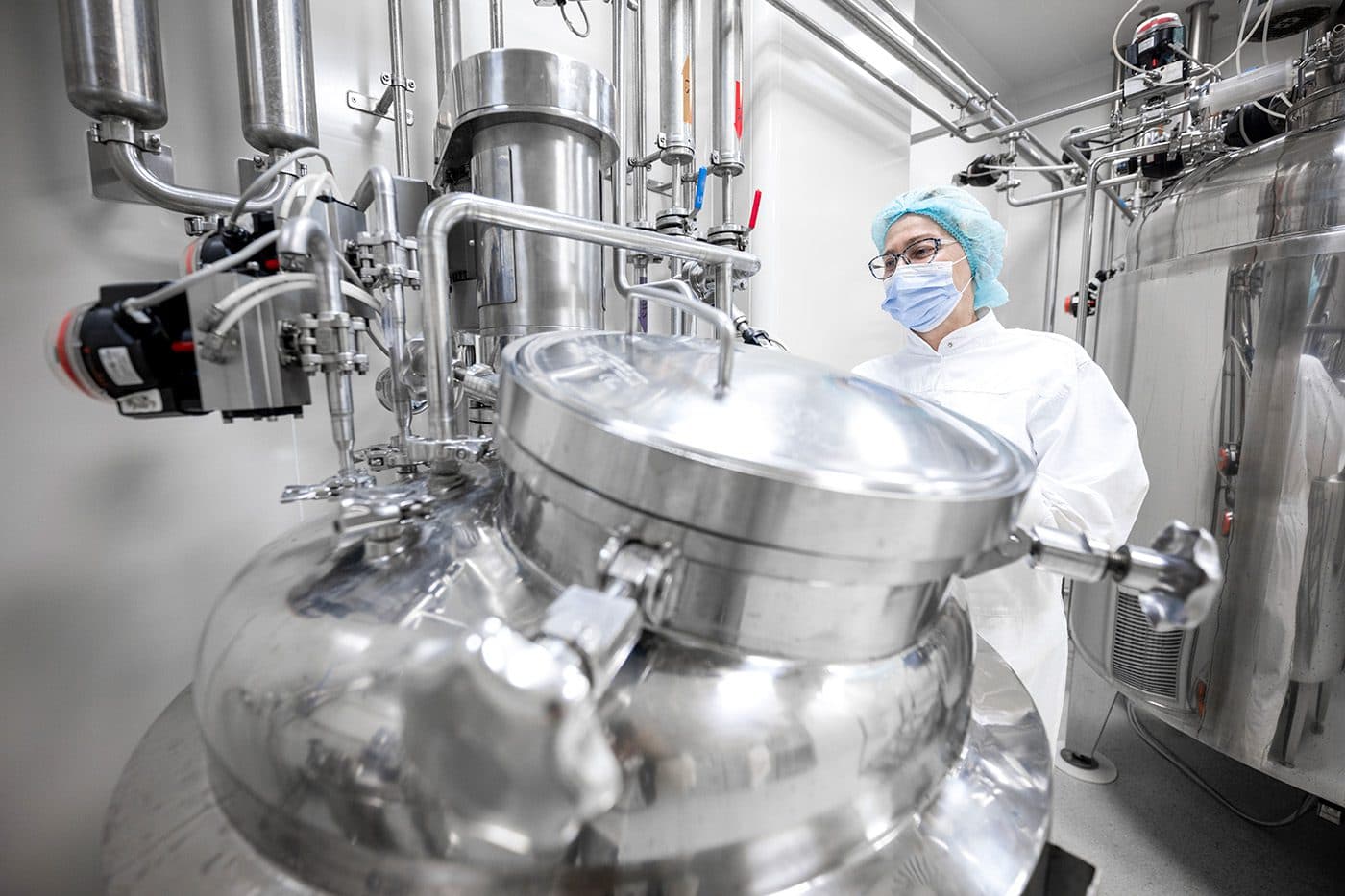
Life science manufacturing jobs fell by 2.1% last year to 143,572 jobs, though they still accounted for more than one-third (35.3%) of all of the industry jobs in the state. Across 31 life science industry sub-sectors, 23 recorded job losses, with the largest declines in medical laboratories and R&D within the physical, engineering, and life sciences job category.
But the state’s life-sci manufacturing segment is eventually expected to grow as drug developers either strive to meet growing demand, reshore their production in the United States to avoid tariffs, or both. Gilead Sciences began construction in September 2025 of a new 180,000 square-foot development and manufacturing facility, part of a companywide $32 billion U.S. investment strategy. Two months later, Novartis opened a 10,000-square-foot radioligand therapy (RLT) manufacturing facility for cancer treatments in Carlsbad, CA, the pharma giant’s third U.S.-based RLT site.
While biopharmas and contract manufacturers have announced hundreds of billions of dollars in new projects, projects announced for California remain mostly under construction, so hiring levels have not yet risen to account for the new manufacturing activity, Scott said.
Potential challenges loom
Two more potential challenges loom for California life science companies—one from Washington, the other from Sacramento.
Scott said BIOCOM California is paying attention to federal efforts aimed at further scrutinizing activity between U.S. and Chinese biopharmas.
Earlier this month, Reps. John Moolenaar (R-MI), chairman of the Select Committee on China, and Congresswoman Debbie Dingell (D-MI), introduced the Biotech Investment National Security Act (BINSA). BINSA would amend the Comprehensive Outbound Investment National Security (COINS) Act, enacted last year, by adding pharmaceutical and biological product development to the list of sectors subject to screening of investments by the U.S. government.
The measure would subject U.S. pharmaceutical licensing deals, joint ventures, and equity investments with Chinese covered foreign persons to U.S. Treasury Department review, as well as explicitly cover licensing deals involving technology and intellectual property. BINSA also requires the Secretary of War (formerly Defense) to assess within 60 days whether U.S. capital investment in Chinese biotechnology negatively affects national security and military readiness.
“We’re trying to find the balance between protecting American interests with regard to intellectual property and also competing with China. And we’re balancing that with cooperating with China,” Scott said. “You can imagine a politician in Washington, D.C., wants to really protect our interests. A biotech entrepreneur in California wants to go anywhere in the world to find resources to be able to move their drug toward the clinic.”
In Sacramento, Gov. Gavin Newsom, who leaves office at year’s end when his second term expires, has proposed permanently limiting the amount of business tax credits that a corporation can claim each year. Starting in 2027, corporate taxpayers would be allowed to claim a maximum of either $5 million or 50% of their pre-credit tax liability, whichever is greater. The limit would not affect taxpayers with less than $5 million in credits.
According to California’s Legislative Analyst’s Office (LAO), recent tax collection data shows that fewer than 100 corporate taxpayers in California would be affected. LAO has estimated that the proposal would raise $850 million in 2026–27, since the cap would only apply to part of the fiscal year, and $1.7 billion to $1.8 billion annually between 2027–28 and 2029–30.
However, the R&D credit likely accounts for most of the proposal’s fiscal effect, according to the LAO, since the R&D credit accounts for the overwhelming majority of business credit usage and carry-forward balances. And the roughly 100 affected businesses include many of the largest biopharma giants, Scott said.
“That is a really big tool for engaging pharma and encouraging investment in California. Without the R&D tax credit, companies are less likely to want to invest in California,” Scott asserted. “The R&D tax credit has had a direct effect on driving the growth of the biotech industry in California.”
GEN EdgeIndustry NewsNewsDrug development (Research and development)Drug research and developmentEconomic policyEthics, law and policyGovernment policy makingPolicyPublic policyRegulatory policiesResearch and developmentScience policyPrevious article
Gene Editing Pioneer Sangamo Files for Chapter 11 Bankruptcy; Agrees to Sell AssetsNext article
Spotlight on RNA TherapeuticsAlso of Interest
Samsung Biologics Signs $262 Million Manufacturing Agreement with European Pharma FirmTop 10 Contract Development and Manufacturing Organizations 2026The Analytical Blueprint for Cell & Gene Therapy SuccessNavigating the Regulatory Labyrinth: How Biotech Leaders Are Rethinking Strategy in an Uncertain Regulatory EraRegulatory Demands for More Process Control Data Fueling InnovationAprea Expands Development of WEE1 Inhibitor After Seeing Early Clinical Activity Signs vs. CancerRelated Media
Small Molecules, Big Expectations: How CDMOs Are Helping Sponsors Navigate Complexity, Speed, Scale-Up, and SustainabilityReporting Live from JPM 2026: Alex Philippidis and Jonathan Grinstein, PhDWhat’s in Store for 2024? Three CEOs Look Ahead and Look Back on “Close to the Edge”Excitement in Oakland: A Report from SynBioBetaBIO CEO Rachel King Outlines Industry's Challenges on "Close to the Edge"Celebrating DNA: Matthew Cobb's Reflections on the Double HelixTop 5ResourcesRecommended For YouPodcast
Touching Base
Touching Base is the dynamic podcast series from the editors ofGEN. Each episode features a rotating case of senior editors—including John Sterling, Kevin Davies, Julianna LeMieux, Alex Phillippidis, Uduak Thomas, Corinna Singleman, and Fay Lin—who delve into emerging stories, exchange ideas, and debate the latest trends in biotech. Additionally, they talk to some of the leading voices in the industry about what's now and next.Start listening today!
Stay up to date with the lasted episodes of Touching Base bysubscribing to theGENPodcast Newsletter