Sign in
Welcome! Log into your account
Forgot your password? Get helpPrivacy PolicyPassword recovery
Recover your password
A password will be e-mailed to you.
GEN – Genetic Engineering and Biotechnology NewsHomeTopicsInfectious DiseasesMalaria Mosquito Bites Turned Into Immune Boosters in New Chemovaccination Strategy
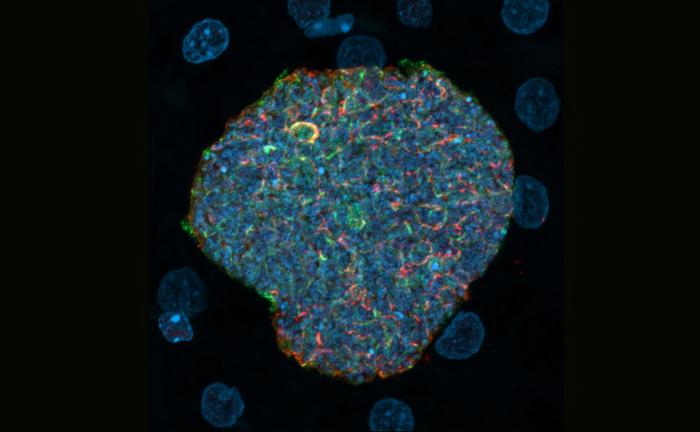
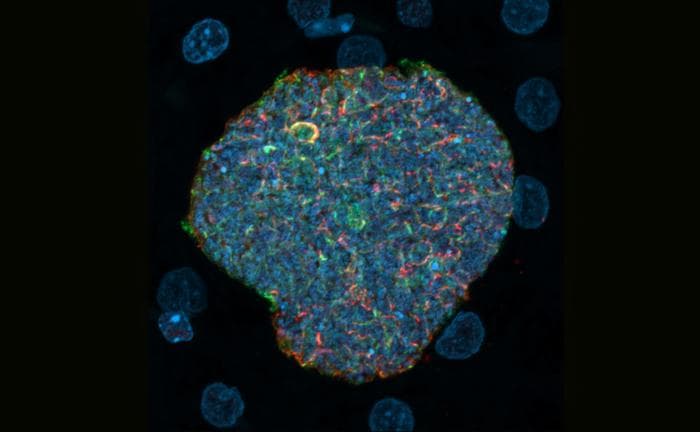
A late liver-stage malaria parasite growing inside an infected liver cell (hepatocyte), expressing different antigens for immune education (red and green). DNA from the parasite (center) and neighboring uninfected liver cells (smaller circles) are shown in blue. [WEHI]
More than 600,000 people—predominantly pregnant women and children under the age of five—die from malaria every year. According to the World Health Organization, one child in Africa dies from malaria every two minutes.
Plasmodiumparasites multiply and mature in the liver before exiting the tissue and infecting red blood cells, triggering the symptoms of malaria. Vaccines that arrest infection during the liver stage ofPlasmodiuminfection can induce potent immunity; however, they have challenges such as complex production and repeated rounds of IV delivery in field settings. With drug resistance continuing to undermine malaria control, there is an urgent need for new strategies to stop infections.
Now, researchers developed a novel immunization strategy, chemovaccination, that paired mosquito-delivered malaria parasites with an investigational class of antimalarial drug compounds. The compounds blocked the parasite’s development at a critical stage of the malaria lifecycle, preventing disease and triggering a robust immune response that provided durable protection against malaria. Subsequent mosquito bites then reinforced this immunity and protection.
In chemovaccination, exposure to live parasites is accompanied by the administration of antimalarial drugs that arrest the parasite life cycle, preventing illness and allowing the immune system to respond to the attenuated parasite.
Now, researchers from WEHI (Melbourne, Australia) have demonstrated that chemovaccination can prime the immune system to fight malaria parasites before they cause disease, with subsequent mosquito bites acting as boosters to strengthen immunity over time—turning mosquito bites into ongoing immune boosters
This approach protected mice against malaria for the study period—a rare outcome that could inform the development of next-generation prevention strategies for one of the world’s deadliest infectious diseases. The study is the first to target malaria parasites at the late liver stage using an antimalarial drug candidate discovered by WEHI and the global biopharmaceutical company MSD (tradename of Merck & Co., Inc., Rahway, NJ).
The research is published inSciencein the paper, “Chemovaccination with a late-liver-stage antimalarial induces durable immunity against malaria.”
“Using this new drug compound, we’ve found a way to turn mosquito bites—the very thing that spreads malaria—into vaccination events in mice,” said Justin Boddey, PhD, associate professor at WEHI. “This represents a shift in the way drugs could be employed to prevent malaria.”
“This means the parasite was stopped just before it could cause illness, while giving the immune system a fuller preview of the potential threats,” Boddey said. “The immune response generated required only a very small dose of parasites but was broader and longer-lasting than most current vaccine approaches. This is because our approach allowed parasites to amplify and then triggered both antibodies and CD8+ T cells to protect against reinfection. Importantly, this included liver‑resident memory T cells, which have the potential to respond rapidly to future infections and eliminate them before disease develops.”
The antimalarial drug candidates used in the study, WM382 and MK-7602, are both dual inhibitors of plasmepsin IX and X—two “master regulators” that are crucial for parasite survival. The drug candidates are the result of a decade-long research collaboration between WEHI and MSD.
John A. McCauley, senior director, discovery chemistry at MSD, said: “Current approaches often rely on genetically attenuated parasites, which can provide strong protection but require high doses and are difficult to produce, scale, and administer in real‑world settings. By using a drug to arrest parasites at the late liver stage, we’ve enabled the immune system to recognize a broader range of malaria antigens using a smaller parasite dose. This approach may provide a broader response against the diversity of malaria parasites seen in the real-world and go beyond what genetically attenuated laboratory strains can achieve.”
As WM382 and MK-7602 target enzymes that are highly conserved across malaria species, researchers hope this will enable their approach to provide protection against a wide range of malaria “variants” in the future—potentially allowing people in endemic areas to build immunity from natural mosquito bites over time. Along-acting injectablebased on the compounds is in preclinical development.
NewsAntimalarialsImmune responseMalariaMalaria vaccineMosquitoesPreclinical developmentAlso of Interest
Immune Cells Driving Alzheimer’s-Like Neurodegeneration Traced to Lymph NodesFrom Images to DataNew Zika Virus Vaccine Approach Harnesses the Power of T Cells in MiceSkull Immune Structures May Provide First Response Against Brain CancerRoundup: Removing Impurities from BiomanufacturingMalaria-CausingPlasmodiumin Uganda Show Rapid Spread of Drug Resistance MutationsRelated Media
Beaming Up: CEO John Evans on the Future of Base EditingGENcast: The Quiet Voice of Immunotherapy That's Starting to Be HeardThe Mystery of Mosquito FlightUltra-Long-Term Drug DeliveryChikungunya Virus Contracted in U.S. for First TimeTop 5ResourcesRecommended For YouPodcast
Touching Base
Touching Base is the dynamic podcast series from the editors ofGEN. Each episode features a rotating case of senior editors—including John Sterling, Kevin Davies, Julianna LeMieux, Alex Phillippidis, Uduak Thomas, Corinna Singleman, and Fay Lin—who delve into emerging stories, exchange ideas, and debate the latest trends in biotech. Additionally, they talk to some of the leading voices in the industry about what's now and next.Start listening today!
Stay up to date with the lasted episodes of Touching Base bysubscribing to theGENPodcast Newsletter
Copyright © 2026 Sage Publications or its affiliates, licensors, or contributors. All rights reserved, including those for text and data mining and training of large language models, artificial intelligence technologies, or similar technologies.
MORE STORIES