Synthetically Engineered Marine Bacteria Could Play Key Role in Decarbonizing the Atmosphere...
Rock weathering is a major regulator of Earth’s atmospheric CO2levels and climate, according to scientists. Throughout Earth’s history, rock weathering has been faster during warm periods with increased atmospheric CO2levels. Dissolved minerals ultimately wash into the ocean, where they draw CO2from the atmosphere and cool the planet again. The weathering cycle occurs over hundreds of thousands of years.
Researchers have wondered if the rock weathering cycle could be sped up, resulting in a number of new companies pursuing Enhanced Rock Weathering (ERW). By scattering crushed silicate rocks on agricultural surfaces or into water, they aim to pull excess CO2out of the atmosphere. Although this strategy is generally safe and environmentally friendly, it is still too slow to affect the global carbon balance or to be economically viable at industrial scale.
Now, a collaborative team at the Wyss Institute at Harvard University, Harvard Medical School’s (HMS) department of systems of biology, and the Stanford Doerr School of Sustainability, has engineered a potential solution to this problem. They published their study “Engineered bacterial siderophore production accelerates rock weathering for carbon removal” inNature Biotechnology.
The researchers, spearheaded by first-author and chemical engineer Neil Dalvie, PhD, from HMS, genetically engineeredAlteromonas macleodii, a widespread marine bacterium, to produce much higher amounts of so-called siderophores, molecules that extract iron from silicate minerals. In customized bioreactors with a continuous flow of seawater, the engineered bacterium sped up the weathering of the silicate mineral olivine by 2.6-fold, boosting the amount of CO2that was removed from air.
“Our study embraces the concept of biologically inspired engineering and how synthetic biology can be applied to enhance normal climate-regulating processes, which ultimately could have a positive impact on our planet,” said Wyss Institute founding core faculty member Pamela Silver, PhD, who, along with Wyss Institute associate faculty member Michael Springer, PhD, led the collaborative research team. “We believe this easily applicable, risk-free environmental engineering strategy could be implemented at many places with real-world decarbonization outcomes.”
Springer, who also is the Elliot T. and Onie H. Adams Professor of Biochemistry and System Biology at HMS, and Silver founded the Synthetic Biology Hive at HMS.
Fast-tracking geology with synthetic biology
During natural rock weathering, silicate minerals like olivine dissolve primarily to release magnesium (Mg), iron (Fe) and silicate (SiO4), trapping atmospheric CO2in the water as bicarbonate (HCO3–). Specifically, the released iron is not soluble when exposed to the atmosphere. Instead, it covers the mineral surface as rust, slowing down the whole process. By producing siderophores, bacteria can capture, solubilize, and take up oxidized (rusted) iron to sustain their own growth. Conveniently, this effectively de-rusts the mineral surface, speeding up rock weathering.
Investigators used custom bioreactors to tease apart when natural bacteria produce siderophores. They found that even a small amount of iron-containing mineral completely inhibited siderophore production, posing a big problem for siderophore production at industrial scales.
“Once wild bacteria have enough iron to grow, they stop making siderophores completely,” explained Dalvie, PhD, who spearheaded the project as a postdoctoral fellow in Silver’s lab. “To enable enhanced weathering at scale, we engineeredA. macleodiito always produce siderophores. We essentially decoupled siderophore production from environmental iron levels.”
While it took the team roughly one month to engineer the microbes, the challenge was showing that they sped up rock weathering and removed more CO2from the atmosphere. To get a handle on this validation, Dalvie teamed up with co-author Amogh Jalihal, PhD, a postdoctoral fellow in Springer’s group at the Wyss Institute and HMS.
“We put our heads together and decided that the measurement would be best at steady state. We needed seawater and bacteria to be continuously flowing over the minerals,” noted Dalvie.
Role for pilot-scale production
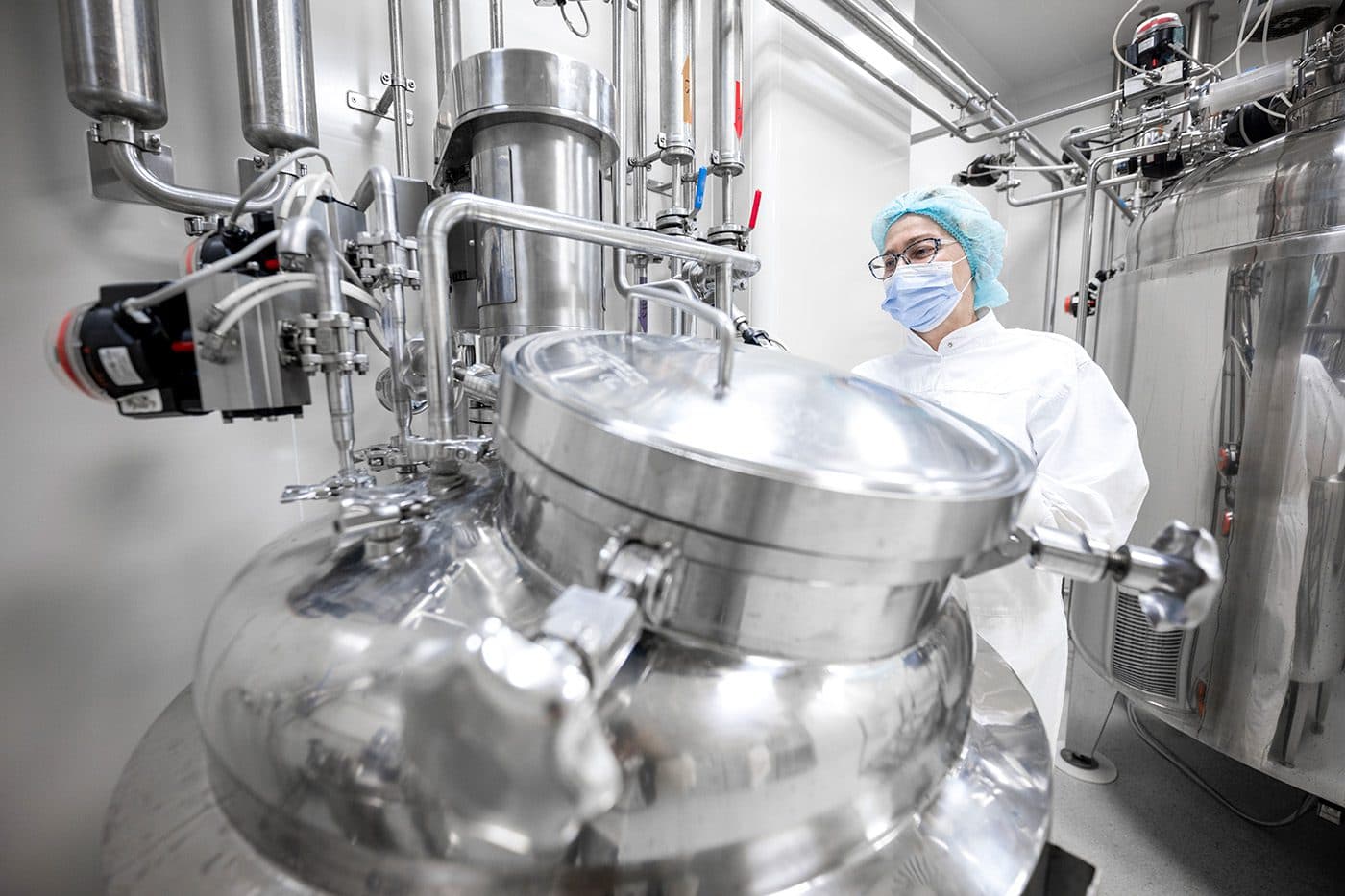
Springer’s group had recently acquired an entire room full of eVOLVERs, small-scale bioreactors. After small-scale studies showed promise, the team constructed pilot-scale bioreactors, loaded with several kilograms of green olivine sand submerged under gallons of raw seawater from the Boston Harbor.
“Operating at pilot scale allowed us to start solving scale-up problems: How often do we need to add cells? How do we feed them? Eventually we were able to measure actual uptake of 0.5 g of atmospheric CO2into our reactors each day, which was a compelling end result,” said Dalvie.
The team also carried out a Life Cycle Analysis (LCA), which accounts for all carbon captured or emitted by the entire system over time, including all living, geological, and chemical parts. Dalvie and Jalihal collaborated with Abigail Fitzgibbon, a PhD student working with Steven Davis, PhD, professor of earth system science at the Stanford Doerr School of Sustainability at Stanford University.
Davis’ group has developed models to quantify the carbon emissions of industrial or agricultural processes and the effects on air quality on human wellbeing.
“Our collaboration with the Stanford group enabled us to precisely calculate the net carbon balance in our system,” pointed out Dalvie. “We could see which process parameters were key to make it an efficient environmental technology when used at industrial scale.”
Dalvie recently received a fellowship from the Burroughs Wellcome Career Awards at the Scientific Interface (CASI) program, which will fund further work on microbial siderophore production and mineral processing. For bio-weathering, more scale-up studies are needed to identify economically viable sources of feedstocks and silicate minerals. The team is also investigating if valuable metals could be extracted from silicate minerals alongside CO2sequestration.
“We are currently thinking that the most straight-forward way of creating environmental impact would be to grow our bacterial strains with adequate food sources in large basins resembling those in sewage plants, continuously pumping unprocessed seawater in and releasing alkaline seawater back into the ocean where the bound carbon would be completely harmless and buffered away,” said Springer, who is studying how evolution has shaped and constrained the interactions of organisms with their environments.
NewsBacteriaBioreactorSynthetic biotechnologyeVOLVERsPrevious article
StockWatch: Revolution Shares Stay Flat Despite Historic FDA Approval of Oral Pancreatic Cancer TherapyNext article
Darpa Awards UC San Diego Up to $11.3 Million for ‘Smarter’ Red Blood CellsAlso of Interest
Top 10 Contract Development and Manufacturing Organizations 2026Harnessing Real-Time DataThe DNA Balancing Act in Boosting Bacterial ProductivitySingle-Use Comes of Age—What's Next?Affordable Bioreactor Helps Prep Students for Biomanufacturing CareersSterilization Posits Biomanufacturing Next Scaling ChallengeRelated Media
BIO CEO Rachel King Outlines Industry's Challenges on "Close to the Edge"The Future of Synthetic Biology: A Discussion with Eben Bayer, Deepak Dugar, and Emily LeproustGeorge Church, PhD, Recounts Decades of Research, 38 Companies on “Close to the Edge”The First Computer-Generated Bacterial GenomeCell-Sized Robots, Mass ProducedType O Blood from Any-Type DonorsTop 5ResourcesRecommended For YouPodcast
Touching Base
Touching Base is the dynamic podcast series from the editors ofGEN. Each episode features a rotating case of senior editors—including John Sterling, Kevin Davies, Julianna LeMieux, Alex Phillippidis, Uduak Thomas, Corinna Singleman, and Fay Lin—who delve into emerging stories, exchange ideas, and debate the latest trends in biotech. Additionally, they talk to some of the leading voices in the industry about what's now and next.Start listening today!
Stay up to date with the lasted episodes of Touching Base bysubscribing to theGENPodcast Newsletter