Sign in
Welcome! Log into your account
Forgot your password? Get helpPrivacy PolicyPassword recovery
Recover your password
A password will be e-mailed to you.
GEN – Genetic Engineering and Biotechnology NewsHomeTopicsGenome EditingUCSD, IGI Partnership Expands CRISPR Innovation Across Health, Agriculture, and the Environment
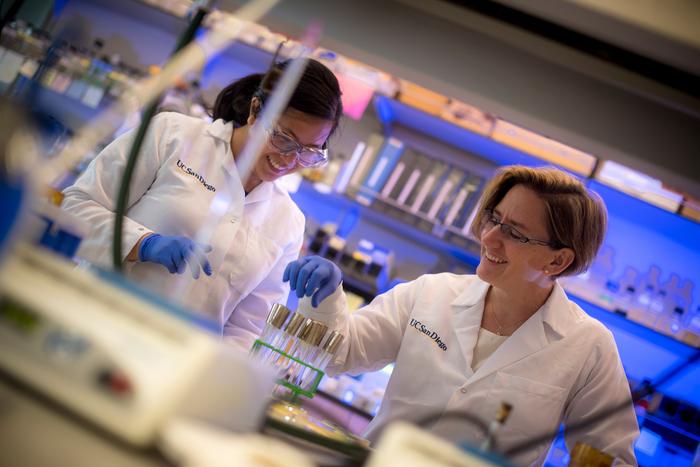
UC San Diego School of Biological Sciences Dean Kit Pogliano (right) will lead the new collaboration for UC San Diego. [Erik Jepsen, UC San Diego Communications]
California may be known as the Golden State, but it may well be referred to as the Genome Editing state after this week’s announcement of an inter-state partnership. The University of California (UC), San Diego, and the Innovative Genomics Institute (IGI), founded by Nobel laureate and CRISPR gene editing co-discoverer Jennifer Doudna, announced a new partnership to jointly develop cutting-edge genomic tools for addressing large-scale challenges in health and the environment.
Doudna founded the IGI in 2015 with the aim of translating the success of gene editing in the lab into practical solutions for large societal problems. Initially formed as a partnership between UC Berkeley and UC San Francisco with a focus on using CRISPR in human health, the IGI expanded to include sustainable agriculture and climate change applications of genome editing, adding UC Davis as a partner. UC San Diego is joining as the IGI’s fourth UC partner campus, combining research strengths in environmental and marine science, engineering and computer science, and biomedical and life sciences to develop the next generation of genome-editing tools and applications.
“I’m thrilled that the IGI is now partnering with UC San Diego,” said Doudna. “The mission of the IGI is to develop solutions that can not only scale to meet the biggest challenges in health and climate, but to make solutions that are accessible to those who need them most. UC San Diego helps us expand that real-world impact.”
[Margot Riggi]
The relationship between UC San Diego and IGI research labs has been building over the past decade. For several years, the IGI has been collaborating with UC San Diego researchers Joe Pogliano, PhD, professor in the Department of Molecular Biology, and Kit Pogliano, PhD, dean and professor in the School of Biological Sciences, on applied microbiology projects. They have worked with UC Berkeley-based labs on developing new therapies focusing on “jumbo phage” for antibiotic-resistant bacterial infections as well as a novel defense strategy against viral infections.
In 2023, UC San Diego researchers were awarded $10 million by the Howard Hughes Medical Institute to explore the biomedical promise of jumbo phage as therapeutic agents. Also in 2023, the IGI received a $70 million gift through the Audacious Project to develop microbiome-editing tools and apply them to problems caused by microbes and microbiome imbalances, including livestock methane emissions and inflammatory diseases like asthma. Other areas of the effort focus on developing more efficient tools for genome editing across a wide breadth of microorganisms to expand the impact of this technology.
In the environmental arena, UC San Diego researchers have worked closely with UC Berkeley labs since 2018 to develop tools for combatting crop pests, managing disease-carrying mosquito populations, and developing safe protocols for environmental applications of genomic technologies.
“UC San Diego brings exceptional strengths across biological sciences, medicine, engineering, computation, environmental research, and ocean science that align powerfully with the IGI’s mission,” said Pogliano.
In addition to the current collaborations, IGI’s executive director Brad Ringeisen foresees multiple areas of synergy: “UC San Diego’s strengths in engineering, medical devices, environmental research, and the microbiome complement IGI’s current research areas, and allow us to expand our societal impact in new ways,” he said.
New joint projects of particular interest include interdisciplinary programs designed to bolster the climate resilience of our oceans and soils through innovative scalable solutions, and combining UC Berkeley’s biotechnology discovery engine with UC San Diego’s biomedical research and health system to improve the drug discovery pipeline for rapid translation across areas like antimicrobial resistance and neurodegenerative disease.
NewsAntibiotic resistanceBacteriophagesCRISPRDrug discoveryGenomicsMicrobiomeAlso of Interest
Revvity Signs Agreement to Acquire Human Cell DesignAI Accelerates Biomanufacturing from Discovery to TranslationAI Drug Discovery Hits a New Bottleneck: Experimental ValidationWatchmaker Genomics Boosts Manufacturing Capacity with Major Boulder Campus ExpansionAprea Expands Development of WEE1 Inhibitor After Seeing Early Clinical Activity Signs vs. CancerMyotisBat Genomes Reveal How They Fight Viruses, Cancer, and Cellular DamageRelated Media
Reporting Live from JPM 2026: Alex Philippidis and Jonathan Grinstein, PhDIn Conversation with Visionary Geneticist George ChurchBoston's Bioprocessing Buzz:GENReports Live from BPI 2025Smart Vector Design for Improved Cell and Gene TherapiesBiotech and Beignets: The News from Day One of ASGCTFrom Functional Genomics to Cell Therapy: The Role of CRISPR-Based Gene EditingTop 5ResourcesRecommended For YouPodcast
Touching Base
Touching Base is the dynamic podcast series from the editors ofGEN. Each episode features a rotating case of senior editors—including John Sterling, Kevin Davies, Julianna LeMieux, Alex Phillippidis, Uduak Thomas, Corinna Singleman, and Fay Lin—who delve into emerging stories, exchange ideas, and debate the latest trends in biotech. Additionally, they talk to some of the leading voices in the industry about what's now and next.Start listening today!
Stay up to date with the lasted episodes of Touching Base bysubscribing to theGENPodcast Newsletter
Copyright © 2026 Sage Publications or its affiliates, licensors, or contributors. All rights reserved, including those for text and data mining and training of large language models, artificial intelligence technologies, or similar technologies.
MORE STORIES